5 Questions We are Asking as the K-12 School Year Begins
September 9, 2026 BlogK-12 has entered a new school year defined by ever-tighter budgets, heated technology debates, and a potential tidal…

This is Part 2 of our three-part series on how GenAI is reshaping the education landscape. In Part 1, we explored the K-12 market, highlighting how AI creates durable opportunities for operational resilience, teacher productivity, and human-centered supports. In this edition, we turn to postsecondary education, where AI is reshaping the value of the degree and driving urgent needs for academic guardrails, heightened faculty and broader institutional efficiency, and workforce-centered reorientation. Looking ahead, Part 3 will examine the workforce sector, where the disruption of entry-level roles is making reskilling and upskilling more urgent than ever.
***
Much of the conversation about generative AI in higher education has focused on plagiarism and detection, but the more pressing question may be the value of a degree itself. If AI can increasingly perform tasks once reserved for entry-level roles, what does a degree truly signal?
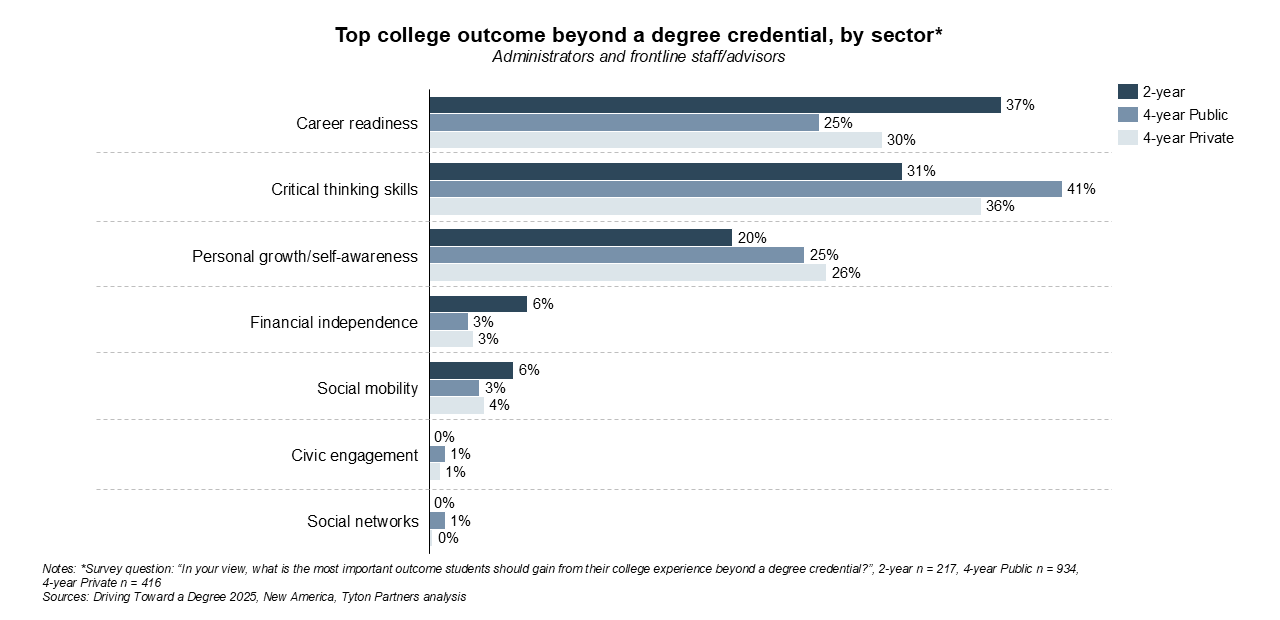
When asked what matters most from college, postsecondary leaders consistently point to career readiness and critical thinking — outcomes that AI disruption is already calling into question. For higher education to maintain credibility and relevance, several critical shifts must occur — near-term supports to maintain learning quality and advance efficiencies, and a longer-term reorientation of the postsecondary experience to meet evolving workforce demands — creating clear opportunities for investors along the way.
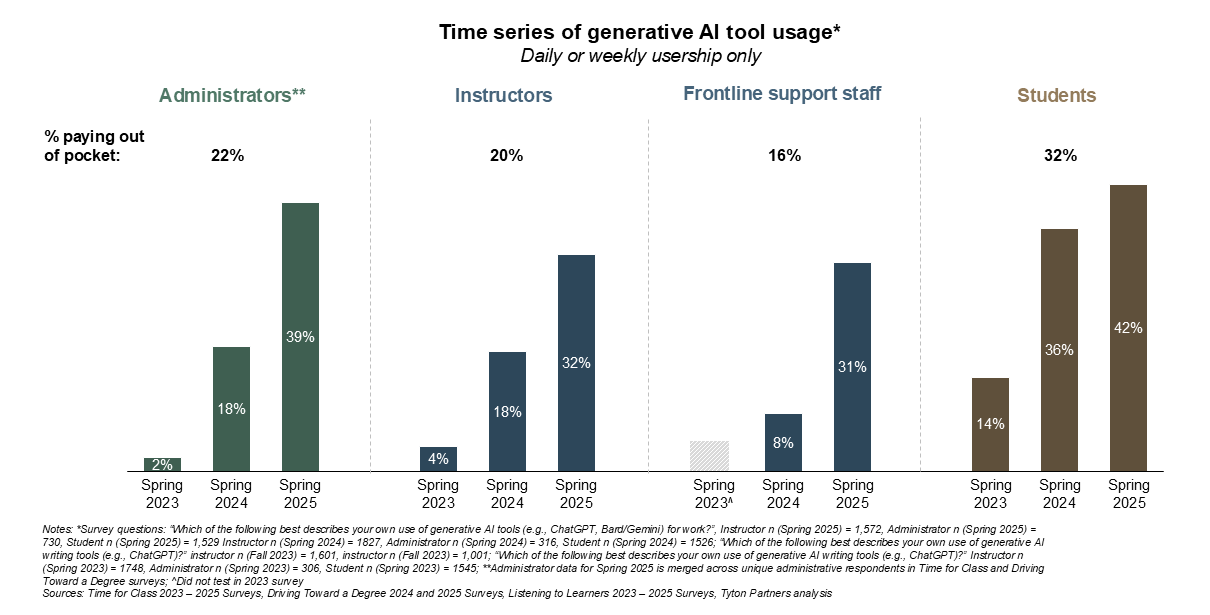
Students have adopted AI tools for regular use at a far faster pace than their instructors. While institutional stakeholders have made significant strides along the adoption curve in the past year (19pp average increase in use on a weekly basis or more), a meaningful lag remains (students +10pp). Earlier adoption has given students more time to become savvy in their use of AI, and they are also more likely to pay for premium GenAI offerings (students +13pp compared to institutional stakeholder average). The result is an environment where faculty lack visibility into how students are completing their work and whether they are learning in the way their institution intended them to.
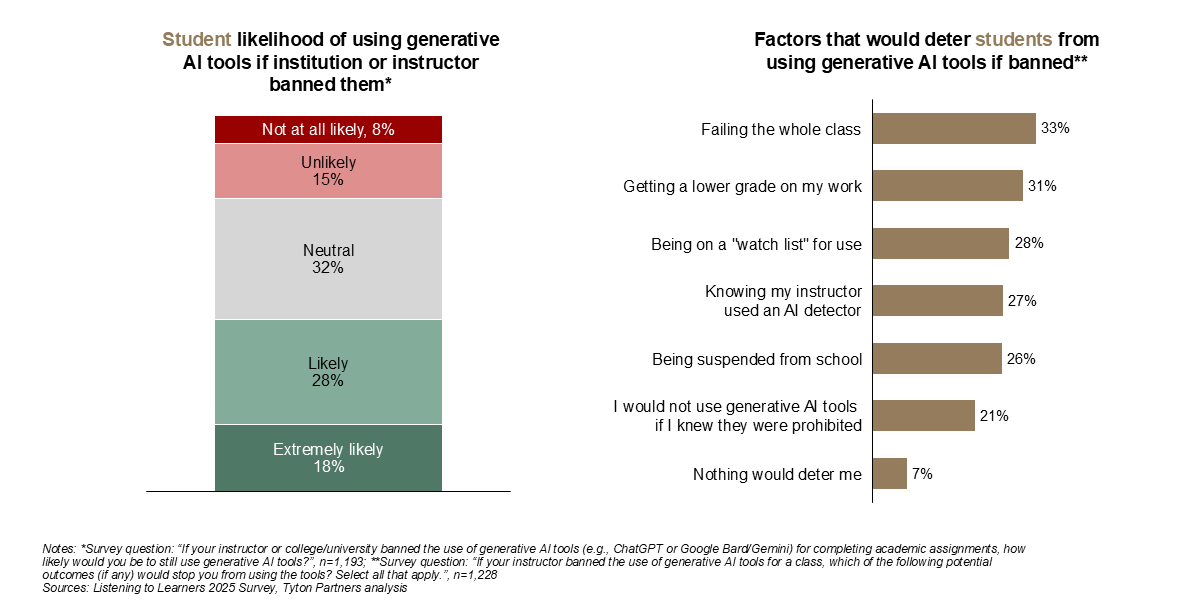
Student AI use alone should not be cause for concern. However, nearly half of students say they are likely to continue using AI tools even if institutions ban them, with only ~20% indicating that prohibition alone would deter them. The message is clear: like it or not, students will seek to leverage AI, and enforcement without infrastructure will fail.
Many institutions are already actively seeking guardrail solutions — AI detection, proctoring, and alternative assessments — to preserve trust in academic work. Established providers like Turnitin, Copyleaks, and Honorlock stand to benefit as demand for scalable integrity mechanisms continues to climb. Newer entrants GPTZero and Winston AI have also enjoyed rapid growth since deploying their respective purpose-built AI text detection solutions early in 2023.
But the real investment signal lies in durability. If students will continue using ChatGPT and other tools to generate answers, the companies best positioned for growth are those rethinking assessment altogether — designing approaches that are less about catching misuse and more about being ChatGPT-proof. Providers leaning into streamlining authentic demonstrations of learning (e.g., portfolios, project-based and oral assessments, simulations) may have greater longevity in their growth curve than those relying on detection alone.
For investors building a thesis, the question is not just who can detect AI today, but who is fundamentally reshaping how learning is assessed in an AI-enabled world. Breakout Learning’s synthesis and rubric-based grading of small-group discussions, Speakable’s generation, administration, and automated feedback for spoken assessments, and Muzzy Lane’s simulations based on learning objectives and instructor prompts exemplify early movers in the assessment revolution that is only just beginning.
As instructors work to AI-proof their courses and verify outputs, a considerable increase in workload has come in tow: 41% cite an increase in workload, up from 34% last year. Instructors who have felt a decrease in workload are largely those that frequently use AI, applying it primarily in support of developing course materials (73%).
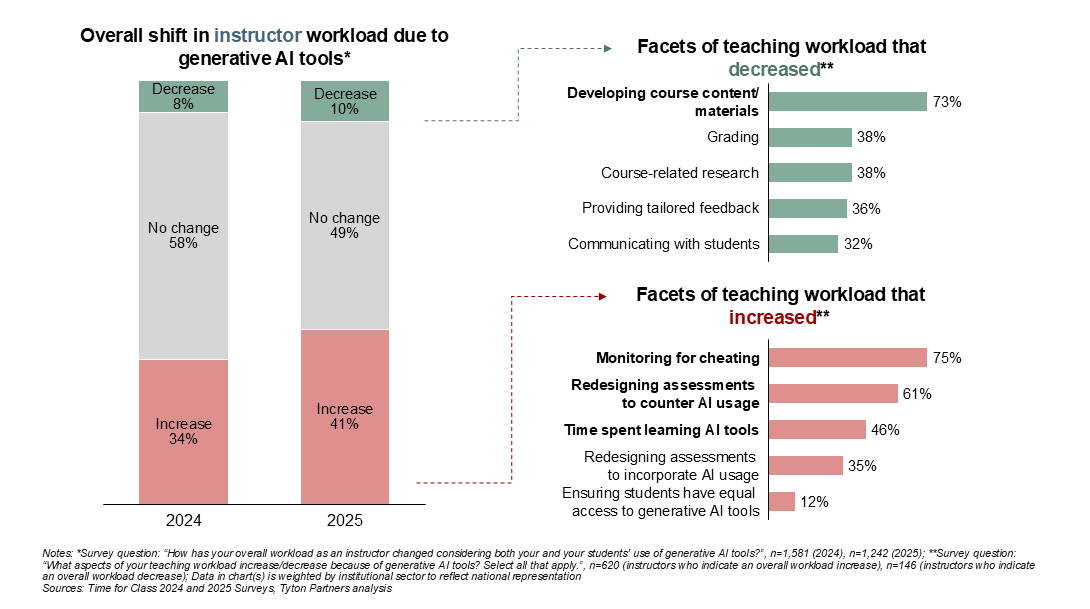
There is pressing need for solutions that make AI an asset rather than a burden in faculty workflows. While traditional LLMs (e.g., ChatGPT, Claude) should continue to benefit from increased institutional stakeholder adoption, buyers desire more purpose-built functionality, integrations, and controls. Faculty, department chairs, and teaching & learning centers will likely increasingly turn to dedicated tools such as Gradescope (Turnitin), Packback, and FeedbackFruits to streamline grading, feedback, and instructional design, even as organic LLM adoption persists.
The institutions most at risk are those that attempt to ignore or separate integrity and instructor workload challenges. Guardrails without efficiency exacerbate faculty burnout, efficiency without guardrails undermines institutional credibility, and inaction risks both. The most durable near-term winners will be providers that can simultaneously safeguard the integrity of degrees while delivering real productivity gains to instructors. Turnitin’s suite that delivers plagiarism detection tools alongside Gradescope and Feedback Studio is a hallmark example.
However, opportunities for efficiencies in postsecondary education exist well beyond instructor workflows. Institutions are also leaning on AI to optimize enrollment, retention, and student support — areas directly tied to institutional revenue and long-term sustainability. Element451 is streamlining enrollment management and advising through predictive analytics and personalized, AI-powered communications, while EdSights uses conversational AI to identify at-risk students and trigger timely interventions. CollegeVine and helps deploy AI agents to streamline communications and operations across campus departments, and Gravyty has built a meaningful niche in AI-powered alumni engagement & fundraising alongside its student engagement suite. While just several examples in a broader movement, for investors, these use cases are compelling: unlike classroom tools, they tie efficiency gains directly to institutional budgets and student success, creating durable opportunities across the student lifecycle.
As institutions grapple with integrity challenges in the near-term, they must also begin to redefine what higher education delivers. AI is steadily erasing many traditional entry-level roles — the “bottom rung” of the career ladder that once gave graduates a way in. While certain occupations are more insulated by nature (e.g., nursing, social work), routine analysis, basic coding, and administrative support are increasingly automated, leaving fewer on-ramps for new talent.
This shift requires a reorientation around durable skills, which employers increasingly explicitly demand. With AI able to handle 50-60% of typical junior employee tasks, students must have intentional training on how to frame problems, ask good questions, and build relationships alongside any technical skill development effort. The Pandemic-era freshmen who enrolled expecting lucrative careers as coders, financial analysts, salespeople, and beyond who now find themselves with completely different employment prospects feel it acutely, and for institutions themselves, the signal is clear: college is only worth paying for if students are set up to get and succeed in a job. 91% of students who believe their college is preparing them well for the workforce believe it’s worth the cost, as compared to 31% among those who don’t.
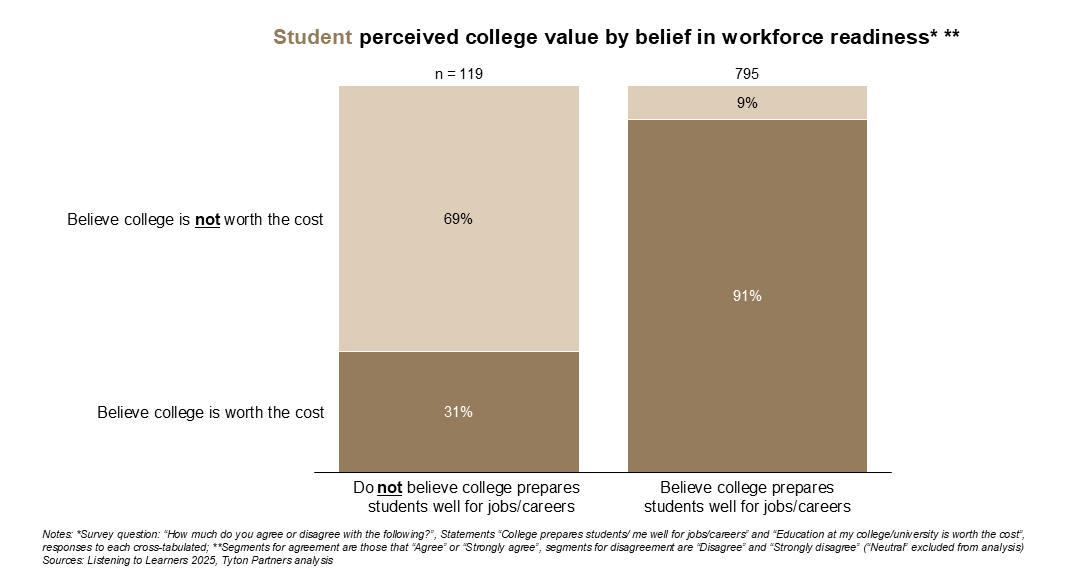
Closing the gap in student real and perceived workforce readiness is key, and providers and institutions that help students acquire, refine, and meaningfully demonstrate durable skills will be best positioned for success. Already, portfolio-based assessments (Portfolium), experiential learning platforms (Forage, Mursion, Podium Education, Skillfully, Stukent), and non-degree credential enablers (Credly by Pearson, Accredible, Badgr (now Canvas Badges)) are emerging as pathways to develop and/or showcase readiness in ways traditional transcripts cannot.
The integrity of the degree and its relevance to the workforce are not sequential priorities — both are urgent. Institutions cannot afford to neglect guardrails that preserve trust, nor can they delay aligning programs with the skills most resilient in an AI-enabled economy. Alongside these efforts, they must also prioritize both resolving mounting faculty workflows and realizing opportunities for AI-enabled efficiencies in institutional enrollment and support efforts. For investors, this creates opportunities on three fronts: near-term bets on providers that deliver integrity and/or efficiency at scale, and a longer-term view toward companies enabling institutions to embed durable, workforce-centered skills into the student experience.
As we continue this series, we will turn next to the workforce market, where reimagining entry-level roles to ensure sustainable talent pipelines is critical, and reskilling and upskilling imperatives are only beginning to take shape.
If you’re considering diligence support, partnership strategy, or just want to better understand how GenAI will impact your position in the education ecosystem, we’d welcome a conversation.