The Federal Scholarship Tax Credit: A New Front Door for K-12 Funding
November 4, 2026 BlogPublic school families are introduced to the choice movement My father spent most of his career as a…

My father spent most of his career as a public high school principal. I met my wife teaching in a public middle school. She was a teacher right down the hallway; I used to send students to her classroom when I lost control, in the same way I now offload responsibility with our tyrant toddlers. We recently bought a house where our search was quite literally filtered around the public school options we thought would offer strong academic and social outcomes for our kids.
All of that to say, we are public school people through and through. And until recently, I didn’t expect the school choice dynamics coursing through the K-12 system (that we frequently analyze) to touch my family at all. What changed is the Federal Scholarship Tax Credit (FSTC), which goes live on January 1, 2027.
For the first time, a federal choice program creates a funding stream that public districts, and the families enrolled in them, can leverage to expand access to educational programming and support services. Below, we outline what the FSTC is and who can access it, the politics behind the bipartisan participation, the scale of potential outcomes over the next few years, and what the implications are for providers and investors alike.
The FSTC was created in the 2025 federal budget law as a section of the tax code. The mechanics of how money moves are new, but the needs it serves should feel familiar to anyone who has watched the recent, rapid expansion of Education Savings Accounts (ESAs). Families can gain access to a potential range of educational options: private schools, academic courses, tutoring, enrichment and other support services. Money flows through four layers:
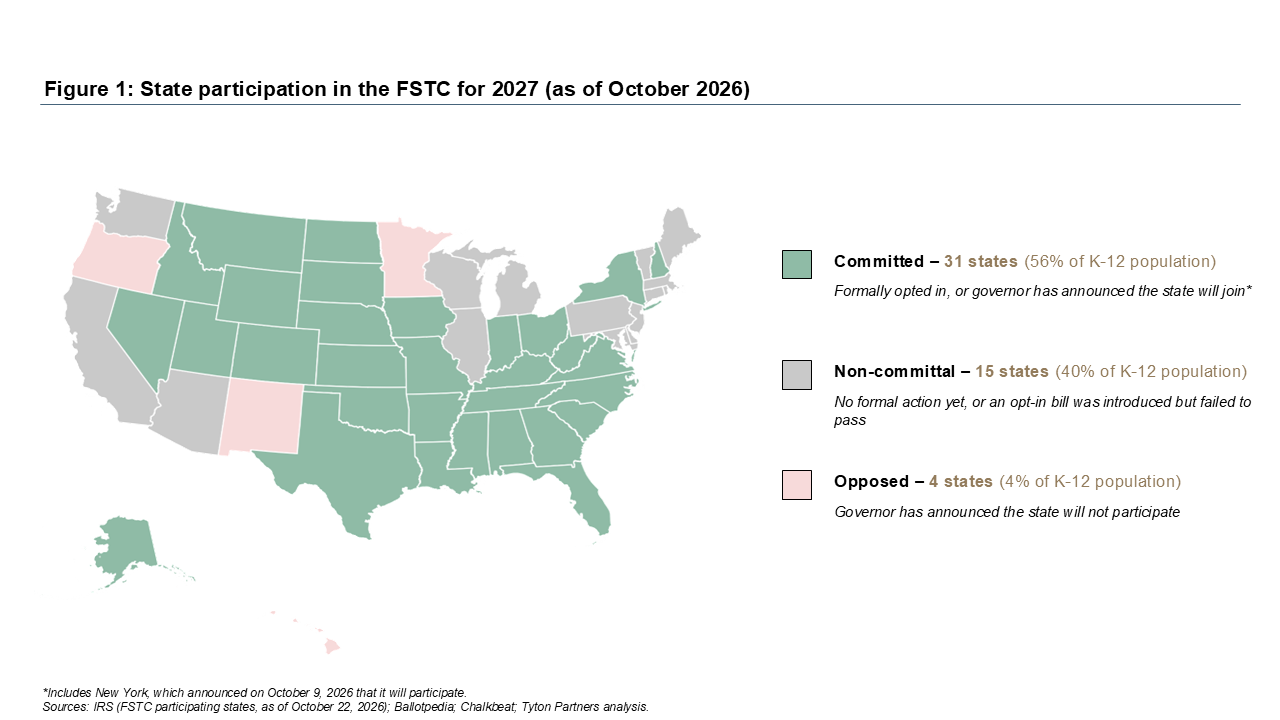
States must opt in to the FSTC, but the political and financial pressure only runs one way. Governors have the power to decide whether their state joins, and 31 states have signed up for 2027 so far (figure 1), spanning every Republican-controlled state, several with divided governments, and Democratic-led Colorado, Virginia and, as of mid-October, New York.
Where governors resisted, as in Kentucky, Kansas and North Carolina, legislatures stepped in and opted in anyway. The reason is simple: people in a state that sits out can still claim the credit by giving to an SGO in a participating state, so staying out risks sending your state’s residents’ tax dollars to other states’ kids. One thing to watch over the next few months is whether that pressure cuts the other way now that the midterms are behind us. Holdout governors may find it easier to join once the election-season spotlight fades, while newly elected governors in the 20 committed states that voted on November 3 could decline to file with the IRS and effectively opt back out, though not right away: outgoing governors are expected to submit their states’ SGO lists before leaving office, so 2027 should proceed as planned, and any opt-out would not take effect until 2028 at the earliest. Legislatures can also step in to keep a state in, as Kansas, Kentucky and North Carolina have shown. Tuesday’s “blue tsunami” makes that question more pressing: Democrats flipped governorships in five committed states (Texas, Georgia, Ohio, Iowa and Nevada), and whether those new governors keep their states in will shape how large the FSTC opportunity becomes. Races in Kansas and Alaska, both committed states, remain too close to call as of this writing.
Where the rules stand. The IRS released draft rules on October 1, but they leave several big practical questions unanswered, such as how service providers get approved and whether before- and after-school and summer programs must run through a school (tutoring providers can already contract directly with families). The public comment period runs through early December, and final rules aren’t expected until 2028, so for now the draft rules will inform and guide states and SGOs, including how the money moves. Still, the opportunity is significant, and providers and investors who are thoughtful now stand to benefit greatly as the rules are sharpened.
How big this opportunity gets depends on how many taxpayers choose to give. There is no good precedent. For example, prior state tax-credit programs have drawn 2% to 3% of eligible taxpayers, but none offered a full dollar-for-dollar credit, and all were capped. The table below shows the range of potential scale.
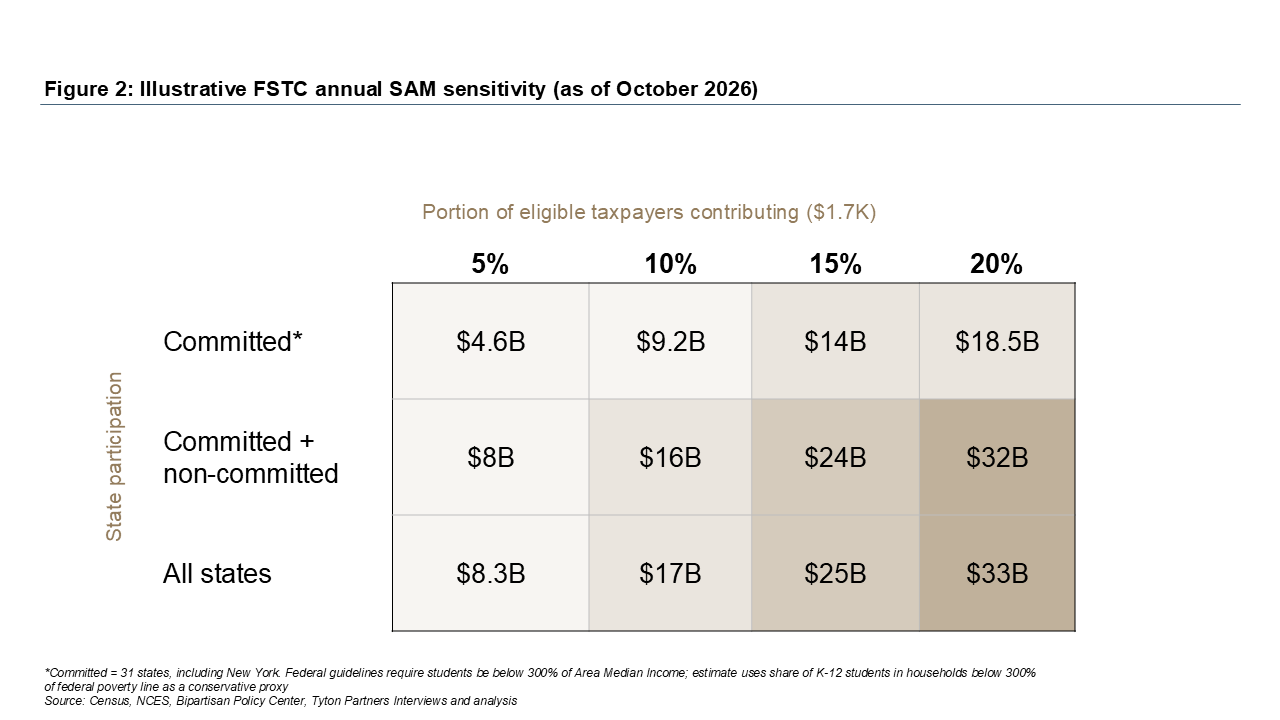
How much of this money is incremental to what’s already in the system depends on how families use it. If most scholarships go to public school families moving into private schools, the net effect is small: districts lose per-pupil funding as those students leave, just as they do with ESAs. If the money instead pays for services on top of what districts already provide, it grows the pie.
We expect the early dollars to follow existing channels toward private tuition. Over time, though, the balance should shift. Anecdotally, donors say they prefer SGOs that serve public school students. Communities like Denver and metro Las Vegas have responded with their district foundations having set up their own SGOs, and new ones organized around public schools, such as Future School Fund, are active. If this trend holds, the FSTC could start to look more like ESSER: new money for the tutoring, enrichment and support services districts want but often can’t afford.
Questions to consider. For investors looking to source deals or support existing portfolio companies, the thesis is simple: families can now use scholarship dollars for academic services such as tutoring, enrichment, and supplemental services, whether or not their children attend a public district school. ESSER was a temporary boon; implemented well, the FSTC could prove more durable and, in time, larger. The sponsors best positioned will be those asking the right questions now:
For providers, there are still more questions than answers about how parents access these funds – and the level of “choice” they will have – but three are worth working through now:
Winners will emerge as the program takes shape, but those who recognize the scale of the opportunity and start to place bets now will likely have an advantage.
The FSTC is a new, uncapped, donor-funded channel into K-12 that is taking shape and will continue to evolve over the next 18 months as Treasury, governors and a few dozen national SGOs fill in the details. At Tyton Partners, we are tracking the implications of state elections, SGO rosters, and the regulatory comment period closely to help K-12 companies and their investors answer the key question: how does this change our market opportunity, and what should we do about it?
If you are new to the FSTC or weighing how it might affect a portfolio company, a diligence target, or your own growth plan, contact us. We look forward to helping you make sense of it.