5 Questions We are Asking as the K-12 School Year Begins
September 9, 2026 BlogK-12 has entered a new school year defined by ever-tighter budgets, heated technology debates, and a potential tidal…

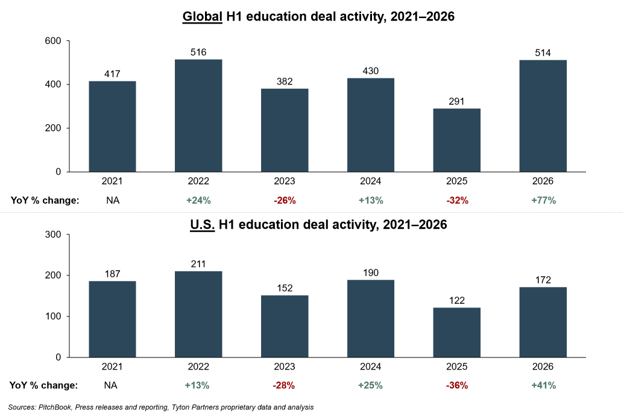
Our last two updates highlighted a similar story. In July 2025 we described a transaction market that was “simply waiting.” In January, we referred to 2025 as a “year of reset”, with the M&A recovery still over the horizon. H1 2026 ends the wait, but not without some important nuances.
Global education deal activity reached 514 transactions in H1 2026, a 77% increase over the 291 deals recorded in H1 2025, and the highest first-half total since the sector’s 2022 pandemic-era peak. U.S. deal volume climbed to 172 transactions, a 41% year-over-year gain. So, is the market finally beginning to turn?
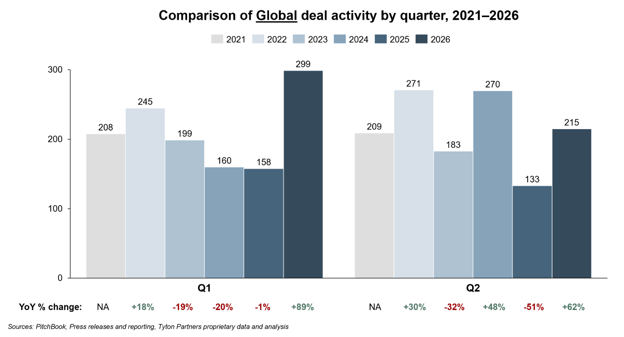
The recovery arrived quickly. The first quarter of 2026 saw 299 global deals, up 89% compared to Q1 2025, and the strongest single quarter since the pandemic peak. Q2 slowed to 215 deals but remained up 62% year-over-year. Since 2021, Q2 transaction activity has generally outpaced that of Q1; H1 2026 reversed that pattern decisively, with the front-half sprint driven by pent-up demand that had been building for two-plus years. However, we believe the market remains muted relative to investor demand and softening interest from those less committed to the sector. Current deal volume can persist if bid-ask spreads and regulatory uncertainty ease, investors gain comfort with the sector’s growth profile, and as sponsors’ “wait and see” approach runs out of runway.
For PE sponsors in particular, LP mandates to deploy capital and to generate exits from portfolio companies held well past historical timelines persists; while it is creating urgency to make moves, it is also reinforcing a discipline lacking for many during the 2021-2022 M&A period.
Some of that pressure was released in Q1, albeit with many investors turning to lower-exposure minority investments and opportunities abroad. The Q2 transaction volume figure is not a retreat but the market settling into a more sustainable rhythm, with both quarters running far above recent downtrends.
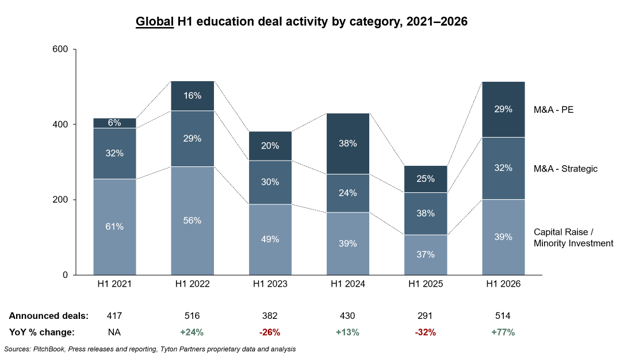
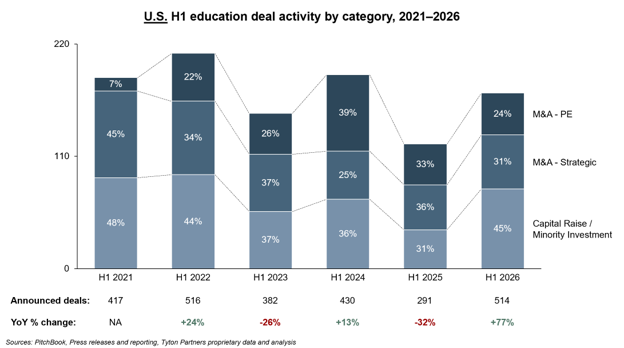
Capital raises and minority investments accounted for a substantial portion of the H1 2026 volume recovery, representing 39% of global deals and 45% of U.S. transactions. In absolute terms, capital raise activity nearly doubled from H1 2025 – 107 to 201 deals globally and 38 to 78 deals in the U.S. Growth- and early-stage investors have re-engaged across geographies and education end markets. For some, this reflects a lower-risk path back into the market without underwriting full buyouts. For the majority, it reflects venture and impact investor appetite to fund new AI-powered approaches across the sector; more than 70% of company descriptions for H1 2026 minority investment recipients explicitly referenced AI product offerings.
While H1 2026 PE M&A volume grew in absolute terms, its share of overall activity remained more modest year-over-year globally, increasing from 25% to 29%; strategic M&A also grew globally, from 112 to 165 deals. Alternatively, sponsor M&A activity in the U.S. declined from 33% to 24% during the same period, highlighting continued domestic market softness, with similar share contraction among strategic M&A as capital raise volume overwhelmed the mix.
The surge is encouraging, but it does not represent the full PE and strategic M&A re-engagement many had been anticipating, particularly in the U.S. Launched processes have continued to stall – as many as ~40% of them within the U.S. PE M&A segment by our estimate – amid persistent bid-ask gaps, ongoing uncertainty from federal policies (e.g., special education), the threat of AI displacing incumbents, broad-based education funding instability, and general concerns about the sector’s growth profile relative to other investment areas. These dynamics are weeding out investors with a generally broader set of industry sector mandates who are struggling to build investment committee conviction regarding education opportunities and theses. However, today’s funded companies are tomorrow’s acquisition targets, and a rebuilt capital pipeline is what sustains strategic and sponsor deal flow over the years that follow.
A separate strategic M&A trend is accelerating horizontal consolidation, as investors and companies seek to rationalize heightened competition across markets. These deals promise a host of potential benefits – catalyzing growth, cost synergies, and more comprehensive coverage of institutional and enterprise customer needs. Notable deals in this area during H1 2026 include:
We expect to see continued momentum in deal activity across both rationales, with more large-scale horizontal M&A similar to ETS+ACT and Coursera+Udemy necessary to tune market ecosystems.
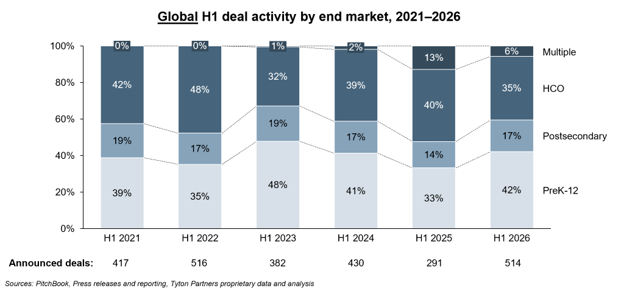
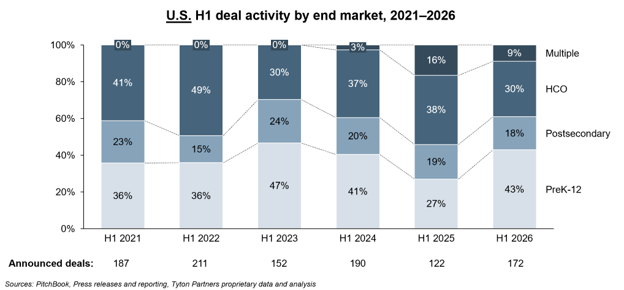
After a two-year slide, PreK–12 reclaimed its position as the most active transactional end market in H1 2026, capturing 42% of global deals and 43% of U.S. deals, up from 33% and 27% in H1 2025.
Despite broader district market headwinds (e.g., public district enrollment declines, post-ESSER budget pressures), PreK–12 activity reflects renewed conviction from strategics and sponsors in specific areas: school-choice-adjacent platforms, career-connected learning offerings, fee-based enrichment models, and early childhood education centers whose revenue does not depend on district budgets.
Out of all PreK–12 deal activity in H1 2026, nearly 25% was in the early childhood segment; of this, 85% – or nearly 20% of overall PreK–12 deal activity – was directed to early childhood schools or centers. Though teaching & learning technologies remained the largest K–12 segment by deal volume, assets with more durable (i.e., non-district-dependent) funding sources have taken share and will likely continue to do so as long as K–12 budget uncertainty persists.
HCO’s share eased from 40% to 35% globally and from 38% to 30% in the U.S. In this segment, the core investment theses remain intact: employer-funded upskilling, compliance, and professional credentialing continue to draw interest on the strength of customer ROI claims and durable, non-appropriations-dependent revenue. At the same time, deals in this segment are most susceptible to the “AI risk” issues raised by ICs, and consumer-oriented models are facing stronger headwinds regarding long-term durability in an AI world. Of particular note, Coursera’s $2.5 billion combination with Udemy, which closed in May, is the defining H1 HCO transaction, a bet that scale confers pricing power in workforce-aligned learning.
Postsecondary deal activity maintained its relative share of activity – thus experiencing an increase in its’ year-over-year volume of transactions – and has some of the most compelling H2 M&A opportunities at this time.
Deals involving assets serving multiple end markets without a clear primary focus contracted sharply, from 13% of global deals in H1 2025 to 6% in H1 2026. The prior two years saw a wave of AI-native platforms claiming to serve every end market simultaneously. The contraction suggests a not unexpected, forced reckoning: businesses that couldn’t commit to a primary customer are increasingly struggling to attract capital on those terms.
The M&A landscape during the second half of 2026 is poised to build on the first. The backlog of PE-held businesses needing exits has only just begun to clear. The LP pressure dynamics felt entering the year remain in force. Strategic acquirers are chasing growth mandates that keep them active across cycles. And, the structural demands underpinning notable education investment themes, from AI-driven transformation to healthcare talent, credentialing, and compliance, are accelerating rather than fading.
In this environment, advantage accrues to investors developing strong investment theses to surface the right deals, not simply those looking for deals. The crowd is both smarter and hungrier, consistent with an environment that will buoy disciplined deal-making.
***
Contact us to learn more about our buy-side and sell-side services and how they can support your investment efforts.