
Student Supports’ Key Hurdle Is Awareness and Capacity
Students don't lack support services. They lack awareness of the ones that matter most and advisors lack the bandwidth to bridge that gap.
Nearly every institution offers academic advising, career services, financial aid counseling, mental health services, and degree planning tools, yet students are largely unaware of what’s available, and even those who know often do not engage. At the same time, advisors are managing caseloads that leave little room to go beyond registration logistics into the career and financial conversations students need.
The services are there. The advisors are there. But closing the gap between what institutions have built and what students experience requires more than better communication. It requires structural relief that frees advisors to do higher-impact work.
What institutions offer and what students are aware of vary
Across nearly every service category, institutional availability is near-universal, yet student awareness and use tell a different story.
This trend is persistent year-over-year suggesting current communication channels are ineffective at moving the needle on student awareness of supports. Even among the categories with the highest awareness this year, student awareness is either flat or down from last year, including across career advising (42% in 2025 vs. 42% in 2026), academic advising (46% vs. 40%), and mental health counseling (41% vs. 36%).
Students most prefer to learn about available support services through campus websites, emails, and orientation, channels institutions have yet to fully leverage for this purpose.
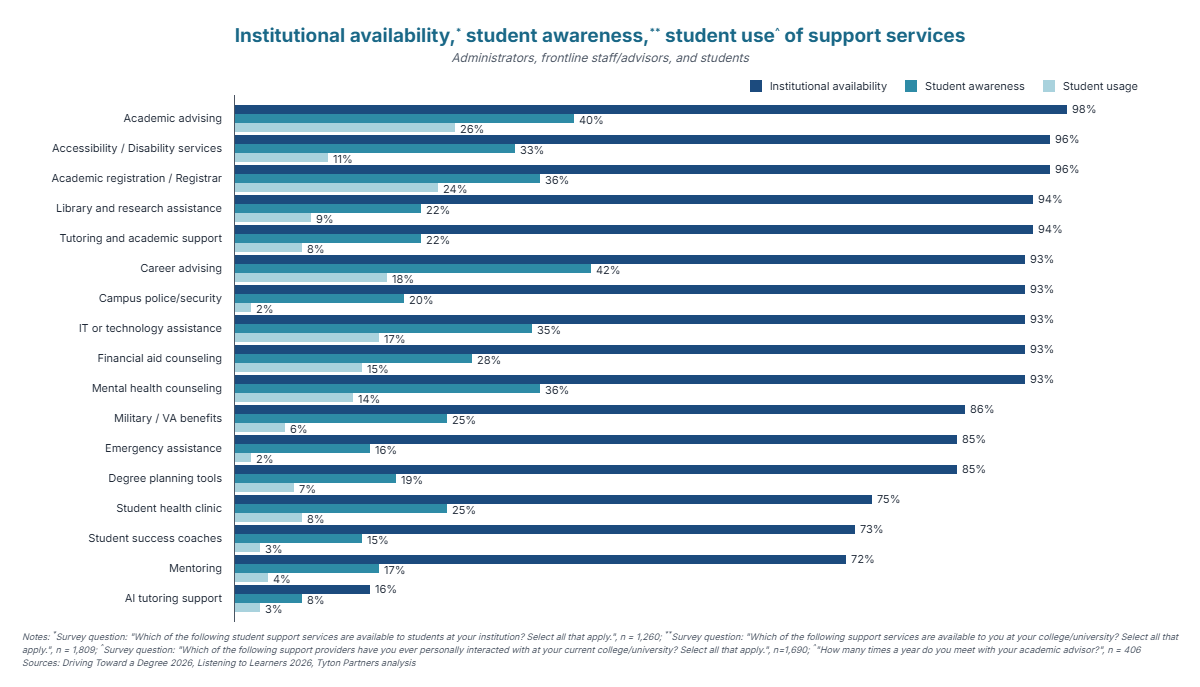
Fully online students report even lower awareness and use in academic advising (aware: 37% vs. 42% among peers, use: 19% vs. 25% among peers). Second-year+ students show modestly higher awareness of registration and disability services than first-years, suggesting awareness builds unevenly over time.
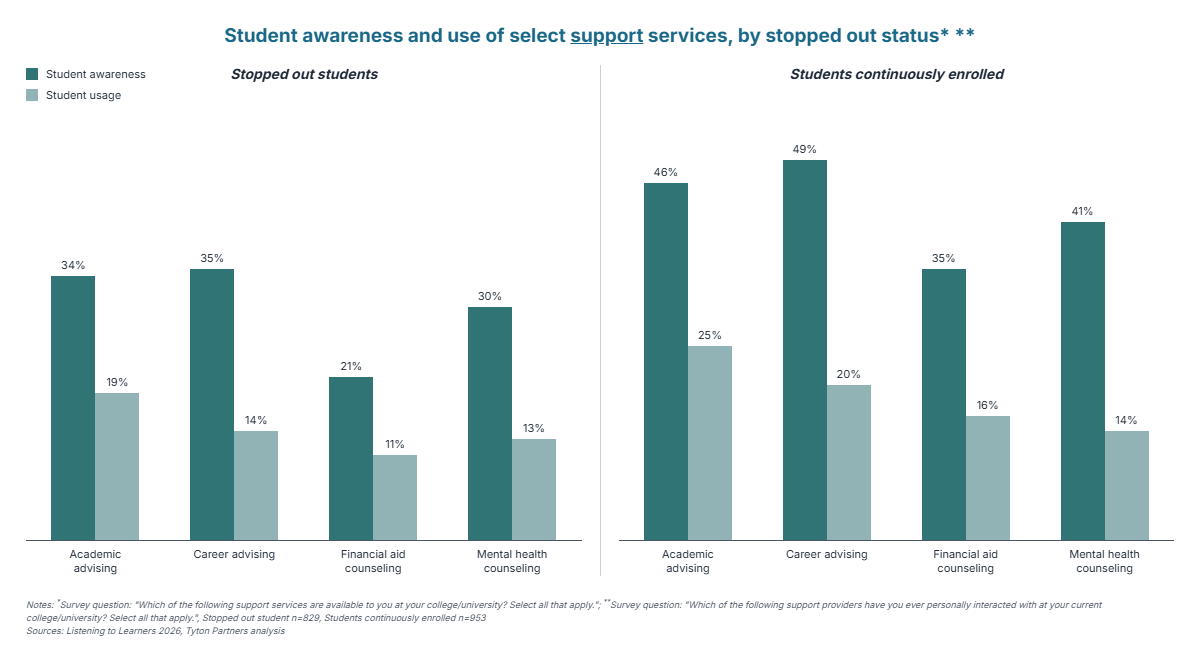
Students who have stopped out are another group that consistently knows less about available support services. Across key services, they are both less aware of and less likely to use support than students who stayed continuously enrolled.
Institutions are misdiagnosing why students do not engage
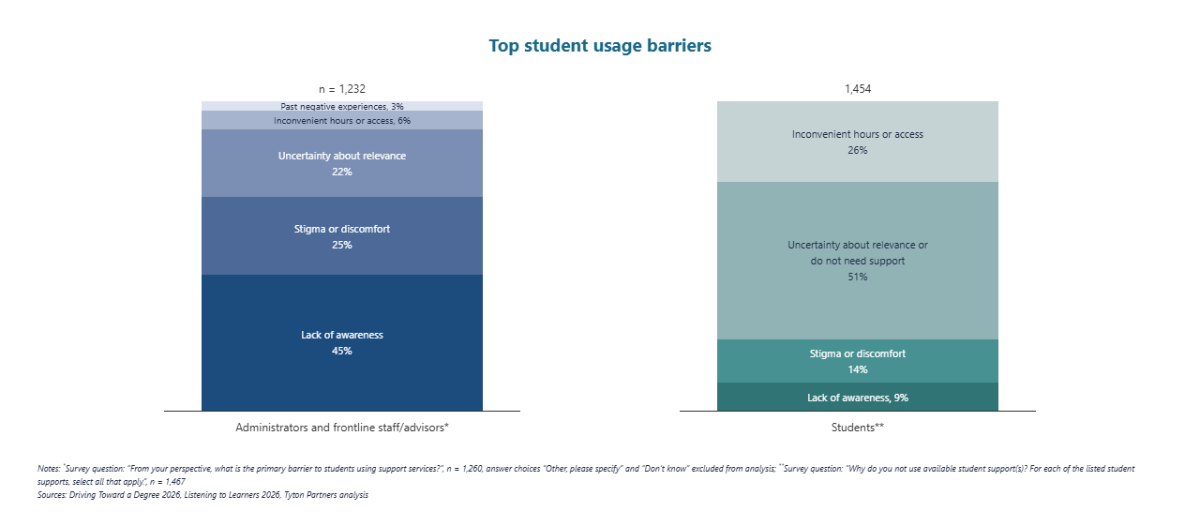
Even when students are aware of available supports, awareness alone isn’t driving utilization. When students who don’t use supports are asked why, just 9% cite lack of awareness. 51% point to uncertainty about relevance or feeling they don’t need the support, and 26% name inconvenient hours or access. Institutional stakeholders, by contrast, diagnose the barrier primarily as one of awareness (45%).
The higher-leverage investments are in making supports feel personally relevant to each student’s situation and removing the friction that keeps even aware students from engaging.
Students and advisors are not aligned on topics of concern
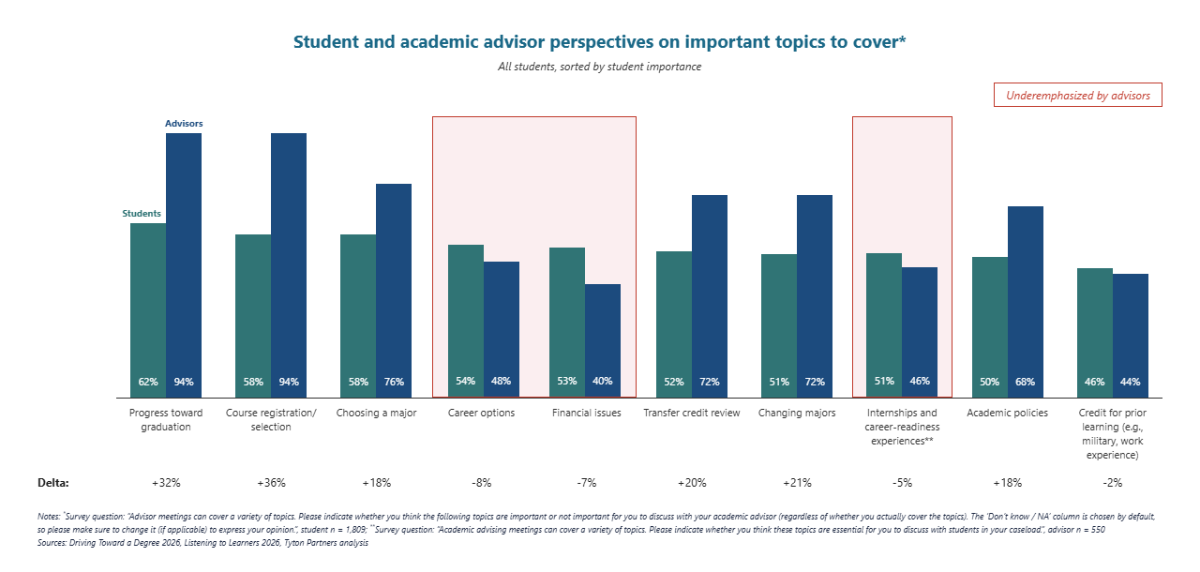
Students flag an average of four essential topics they want to cover in an advisor meeting that runs, on average, between 20 to 30 minutes. With registration and graduation progress occupying the top of most advisors’ agendas, career options, financial stress, and internship planning, the topics students also want to discuss consistently get crowded out. For example:

Advisors managing large caseloads have limited capacity to move beyond degree mechanics into the conversations students want to discuss. AI can help get there by streamlining course registration and scheduling, and freeing advisors to focus on the students’ topics of concern.
Students can create space in advisor meetings for topics they want to cover
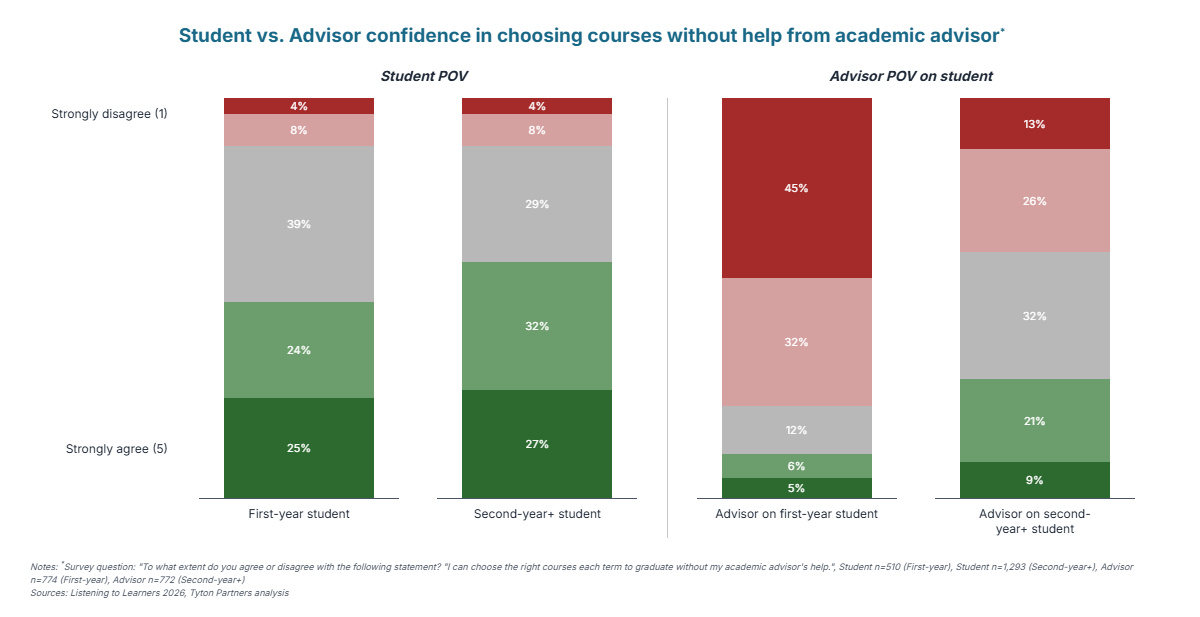
Half of first-year students are confident they can choose courses without their advisors’ help, even more second-year+ students say the same (59%). Advisors are considerably more skeptical: fewer than one in five agree that first-year students can navigate course selection independently, and only 30% say the same for second-year+ students. That skepticism has a practical cost. Advisors already report spending significant time on course selection and registration (as seen in Finding 3). When students come to advising meetings having already researched and chosen their course schedule, the advisor only needs to verify it. That frees up time for the conversations students want to have: career options, financial stress, and how their major connects to a job.
Second year students and older are more likely to use degree planning tools (37%) compared to first years (21%), suggesting support utilization increases with age. When students arrive to advising meetings having already engaged with degree planning tools, and advisors have visibility into what those tools show, course selection becomes a quick verification.
Stopped-out students are underserved, not disengaged
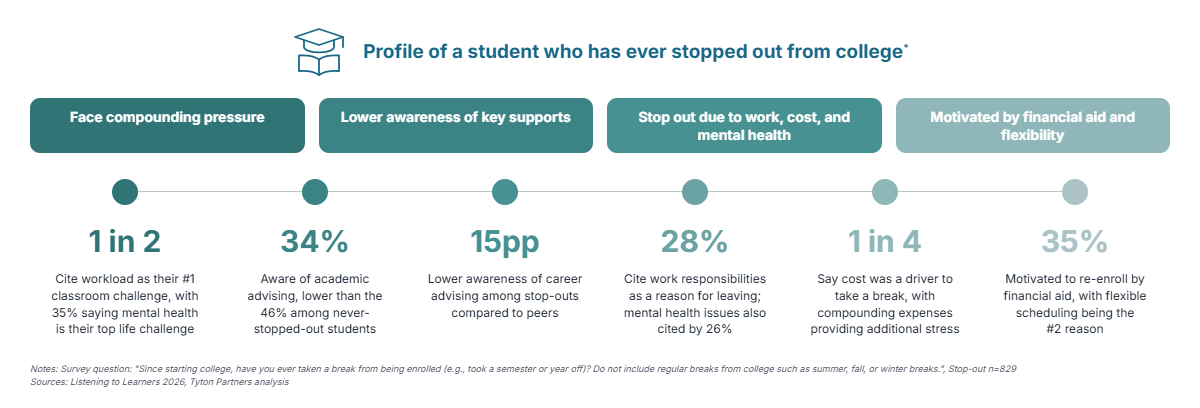
Stopped-out students (over 800 in our sample, representing ~50% of respondents) face compounding disadvantages: lower awareness of every key support, driven out by work responsibilities and cost, and brought back primarily by financial aid and scheduling flexibility. These students aren’t disengaged, they’re under-served.
Serving their needs holistically may look like leading with financial aid outreach and flexible scheduling options, delivered through channels that meet them where they are.
The support services story in 2026 is one of both scarcity and reach. From Driving Toward a Degree 2026, advisor caseloads are high and stay high. Until institutions find ways to relieve that structural pressure, the gap between what students need and what advisors can deliver will persist. The investments in services and tools are largely in place.
What remains is the harder work: reducing advisor caseloads, ensuring every student knows what is available, believes it is relevant to them, and can access it without friction. For stopped-out students, first-generation learners, and those navigating post-grad uncertainty, that reach is not a nice-to-have. It is the difference between persistence and departure.