
Students seek better integrated career preparation
Students want clear career pathways. Institutions' infrastructures are still transitioning from fragmented to holistic implementation.
Career-connected learning has yet to move from some courses to all departments across institutions. Within the existing piecemeal approach, faculty indicate they are embedding real-world projects at twice the rate students report experiencing them. This points to a translation problem, where students are not making the connection between their class projects and their resume needs. The stakes are rising as entry-level job postings in the US have fallen, driven largely by AI. 62% of faculty and students agree students will need AI skills for future careers. Yet students are asking for something simpler, which is a clear line between their major and a career.
Institutions that draw that line, through degree planning tools, career-aligned pathways, and non-degree credentials, will have a meaningful retention advantage.
Workforce readiness means different things to different stakeholders
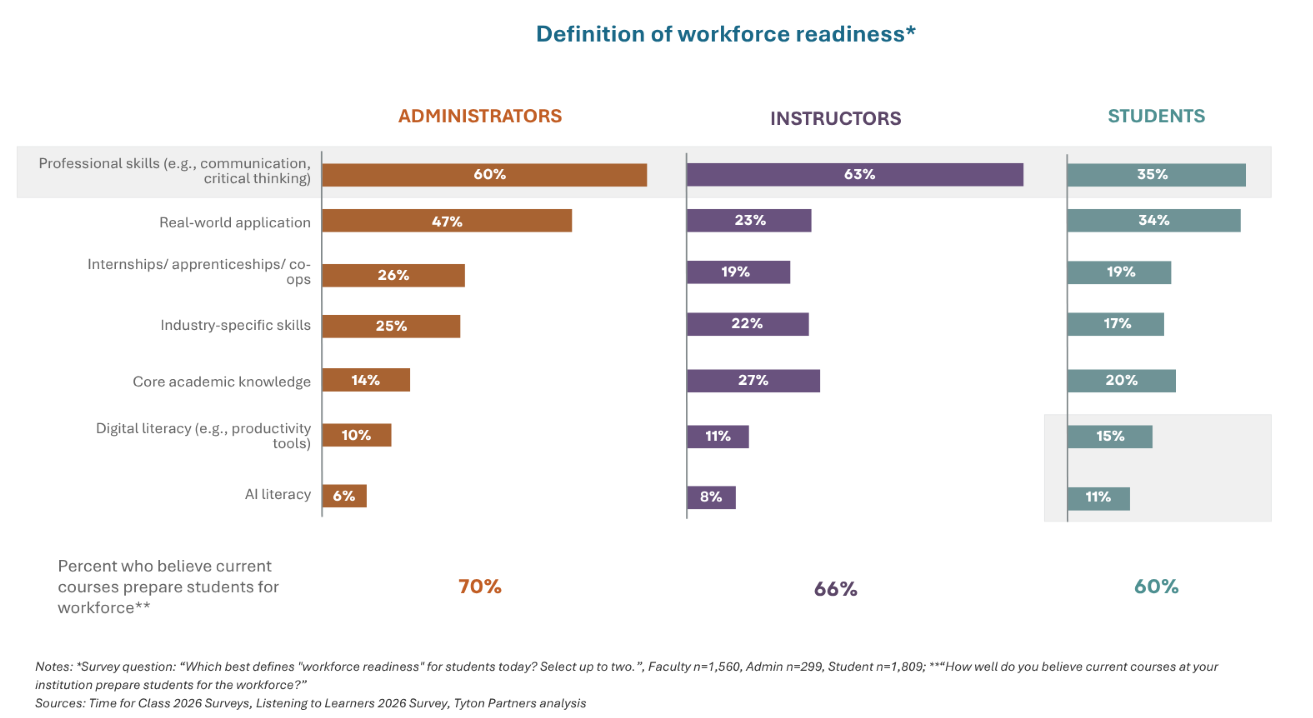
Students equally emphasize professional skills alongside real-world application, while faculty and administrators over-emphasize the former. Students also place more emphasis on digital and AI literacy, showing future-forward thinking in terms of what’s needed for an entry-level job out of college.

Administrators and faculty are more optimistic than students about how well courses prepare them for the workforce. Seven in ten administrators express confidence in course-based workforce preparation, compared to six in ten students. Among faculty, confidence varies by discipline, with health faculty most confident (84%) and STEM faculty least (63%). Health disciplines have long relied on clinical rotations and simulations, giving faculty direct exposure to students completing career-relevant work before graduation. That model offers other fields a template for mapping curriculum to employer needs.
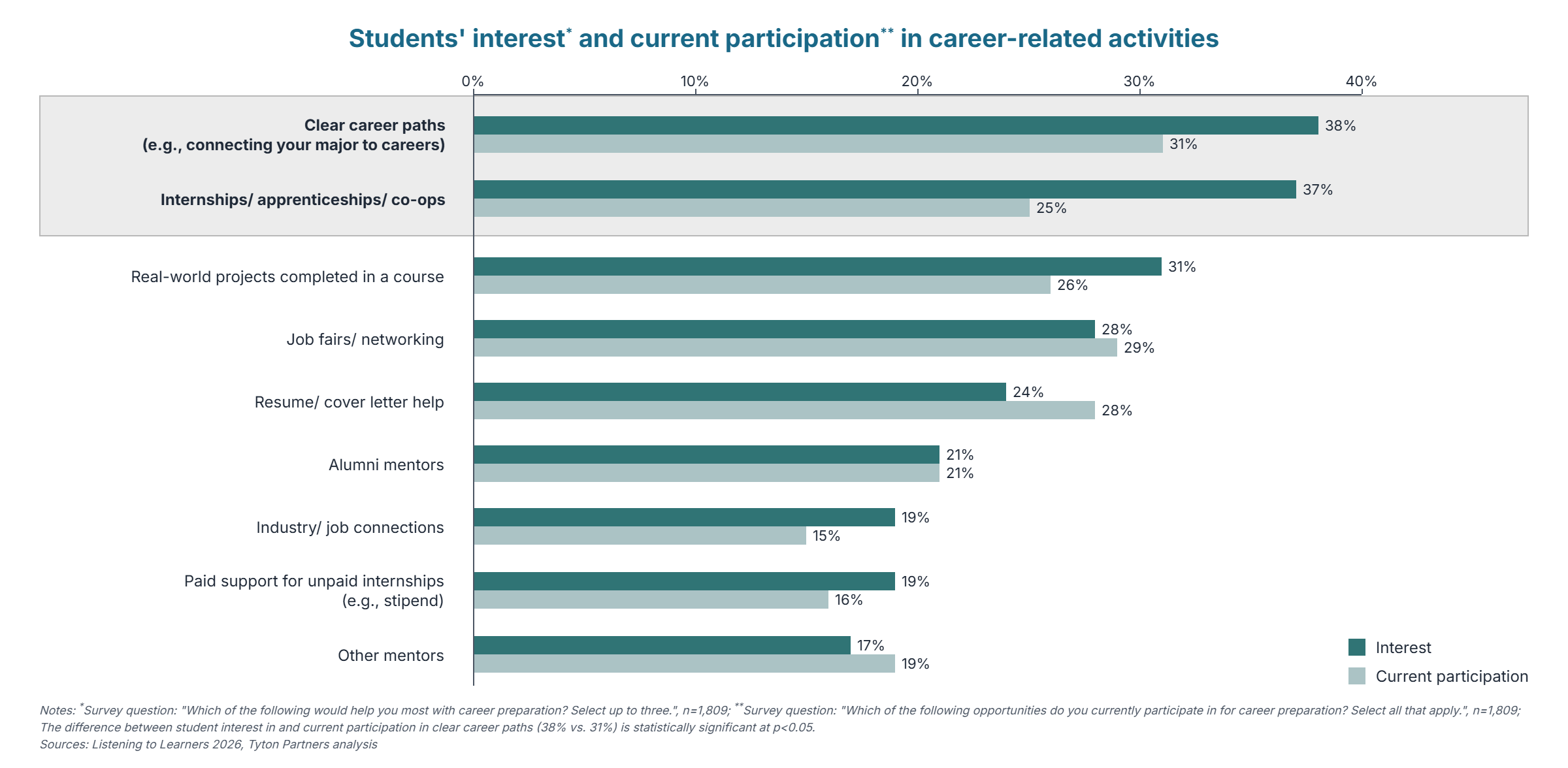
Students want clear career paths and internships
Only 15-30% of students are participating in a career-related activity, highlighting an infrastructure gap to support interest. Students’ top career preparation asks are a clear path from their major to a career and internships. Traditional-aged learners prioritize internships and industry connections (39% and 20%, respectively) while adult learners lean toward mentors (alumni: 24%, other mentors: 21%). Yet across all the learners surveyed, only 31% feel like they can make that career path connection and one in four students currently participate in internships.
Student awareness and interest in Non-Degree Credentials exceeds institutional capacity
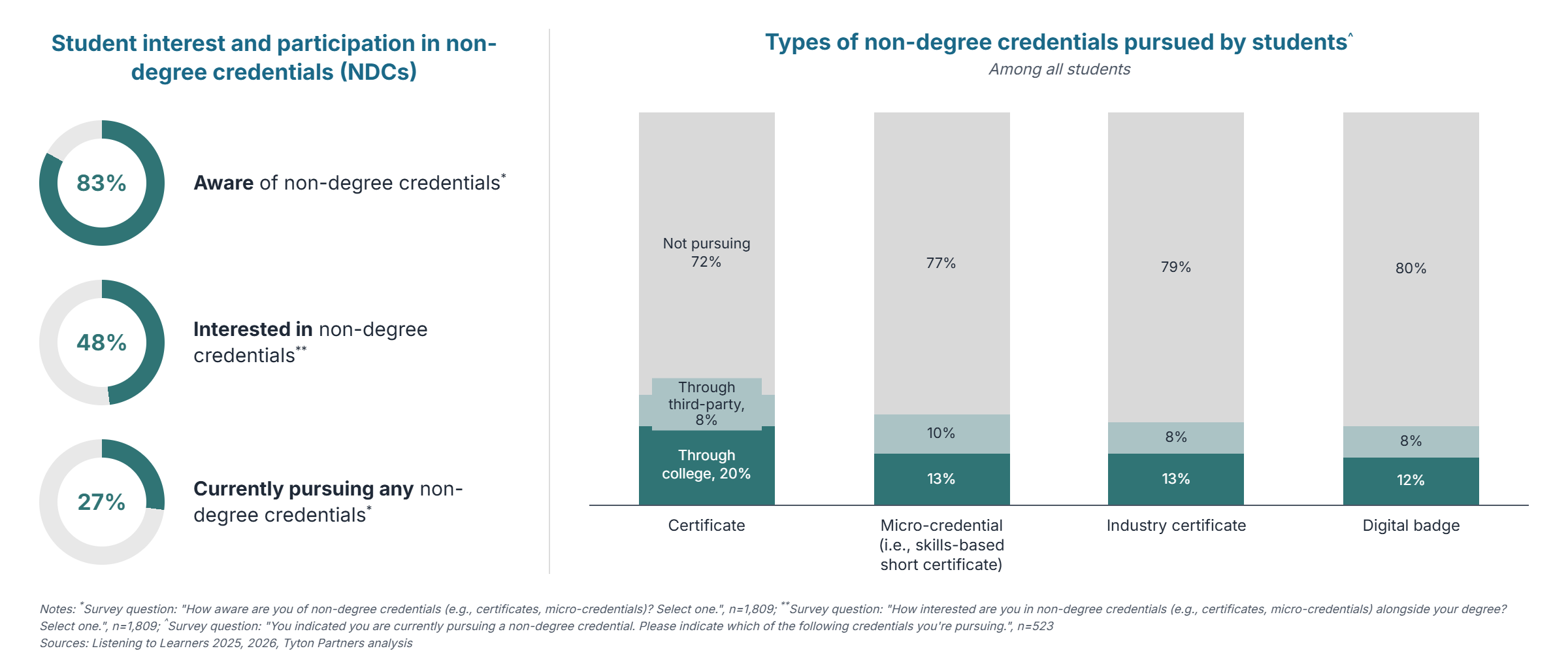
Non-Degree Credentials (NDCs) are one of the clearest ways institutions can answer student demand for demonstrating skills to potential employers. 82% of students are aware of NDCs and 48% are interested but only 27% are pursuing one. Interest has held steady year over year, which means the barrier isn’t demand. It’s delivery.
Institutions that make NDC pathways visible, accessible, and connected to degree planning stand to capture meaningful interest that is currently going unfulfilled.
Students are motivated, aware of what they need, and willing to pursue credentials beyond their degree to demonstrate career-readiness. What’s missing is the institutional infrastructure to connect academic planning to career outcomes in a way that feels real and reachable. Closing that gap is not just a workforce development imperative. Given how tightly career preparation is correlated with retention, it is one of the most direct investments institutions can make in keeping students enrolled.