
Persistence Follows Belonging
Student persistence is not just an academic problem; retention is driven by student sense of belonging and confidence.
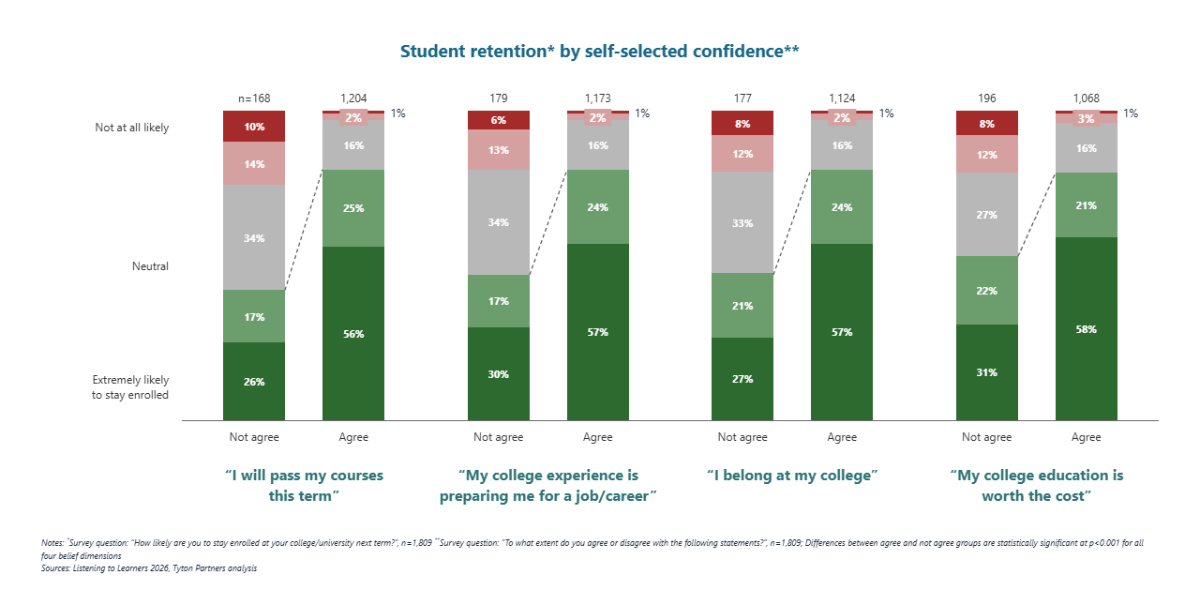
Students who feel they will pass their courses, believe they belong at their institution, and are convinced their degree is worth the investment are significantly more likely to self-report staying enrolled term-over-term.
Institutions and faculty may be focusing on only part of the problem. Institutional stakeholders see skill gaps, but what keeps students enrolled can be elements that a gradebook cannot capture. The other real drivers of persistence are whether students feel like they belong on campus and whether they believe their degree has value. Workload anxiety compounds the challenge, yet it too often goes unaddressed.
Closing that perception gap and investing in the tools and supports that reinforce students’ belief in their own futures are high-leverage strategies for institutions to improve retention.
Institutions are diagnosing a different problem than students
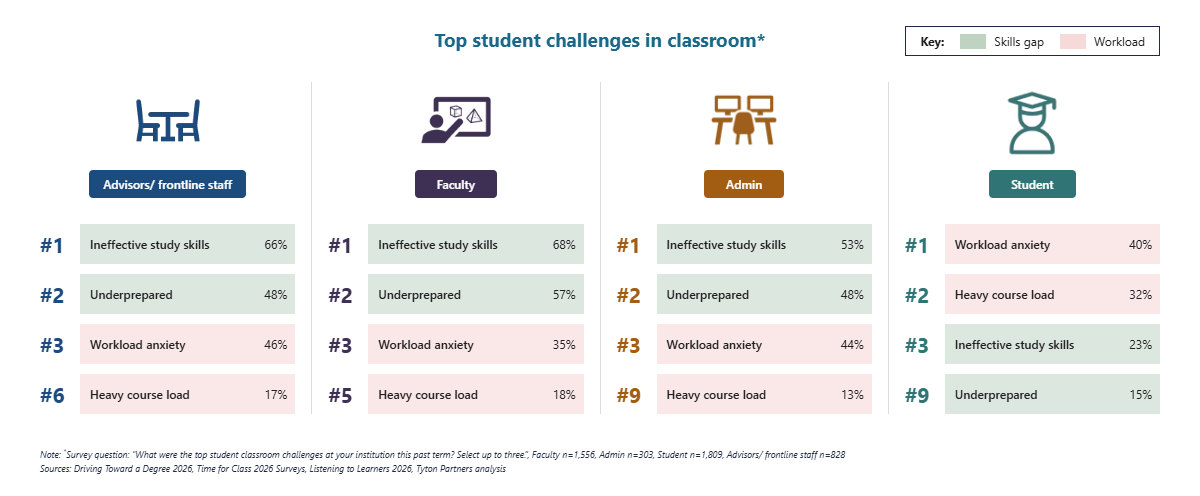
When institutions diagnose the symptom rather than the root cause, they invest in the wrong solutions. Advisors, faculty, and administrators rank ineffective study skills and underprepared students as the top classroom challenges, but students point to workload anxiety and heavy course loads. This holds true across student disciplines pointing to the consistent challenge faced by all.
Mental health pressure does not stay outside classrooms
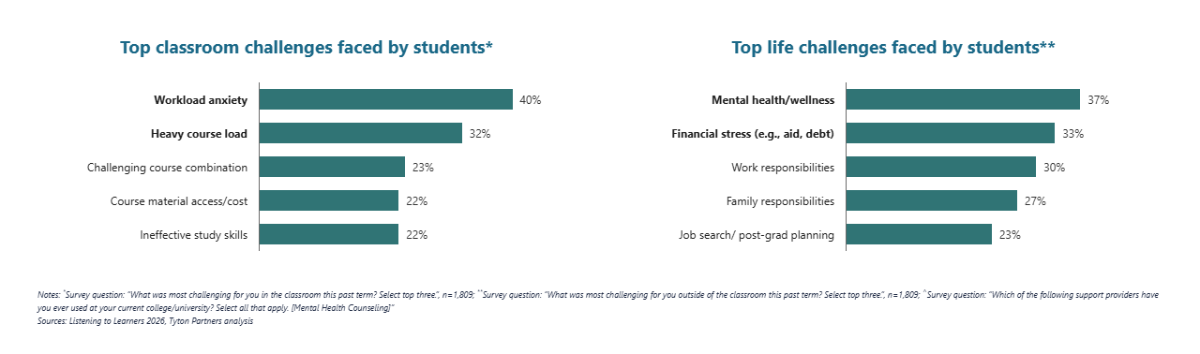
Mental wellness has been students’ top out-of-classroom challenge for three consecutive years, and it compounds in the classroom. Students who flag mental health as a top challenge are more likely to struggle with workload anxiety and low motivation. Wellness challenges vary across students, but their impact converges in the classroom. In their own words, students describe how pressures outside of class disrupt their ability to learn:

Retention reflects academic success and a felt sense of support
For students, the pressures on persistence are personal:

When students feel that they belong at college and that their degree has value, persistence follows. Across key belief dimensions, students who agree are more than twice as likely to report being extremely likely to re-enroll compared to those who don’t.
Awareness of more than four support services also drives re-enrollment likelihood to 84%, versus 67% among students with lower awareness. Retention, in other words, reflects both academic success and a felt sense of support. For solution providers, this means academic risk indicators tell only part of the story. Embedding wellness and sentiment checks into the student experience surfaces the risks that grades and course activity may miss.
Degree planning tools are underutilized given potential persistence benefits
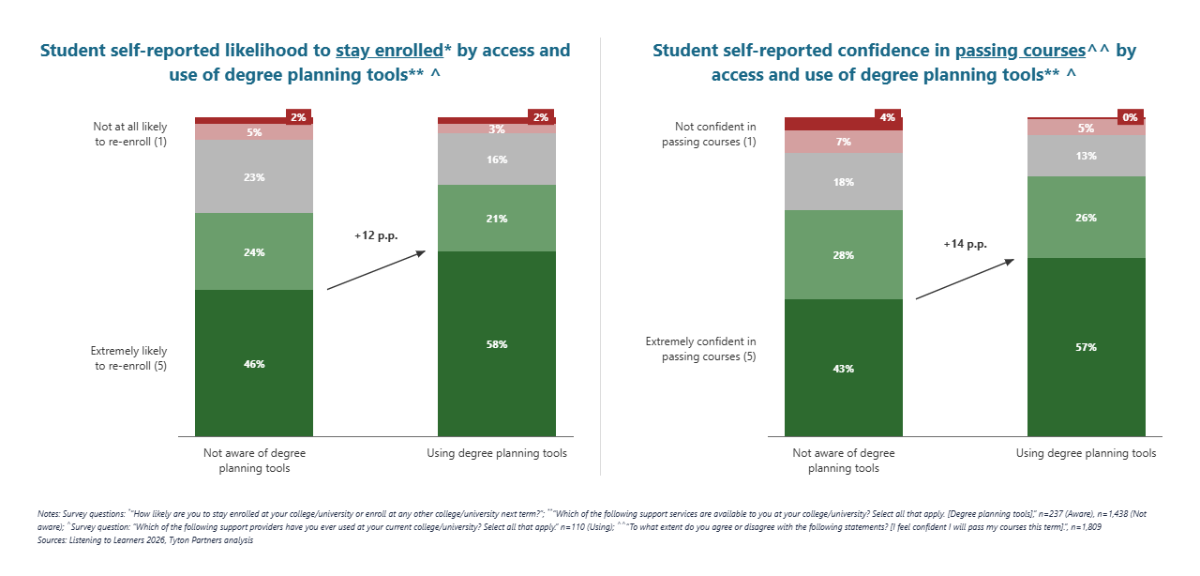
Across solution categories, access to degree planning tools drives likelihood to re-enroll with statistical significance. Students who have access to degree planning tools are 12 percentage points more likely to re-enroll than their counterparts – and their sense of academic confidence is 14 percentage points higher.
Yet degree planning tools sit in the lowest-utilization quadrants of the data. Available at 85% of institutions, they reach only 19% of students in awareness and 7% in actual use. The gap isn’t in what institutions have built. It’s in whether students can find it, believe it’s relevant to them, and access it without friction.
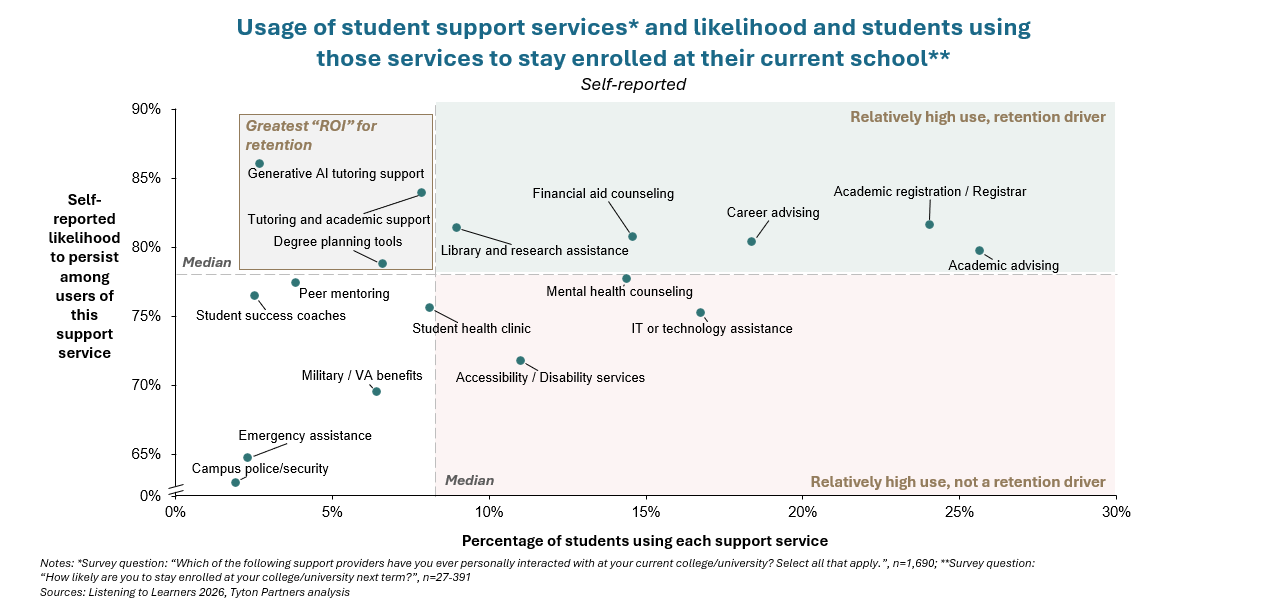
Based on self-reported data, helping students see a pathway towards successful attainment of a degree, is positively correlated with two retention outcomes: passing courses and staying enrolled.
There is no single lever to pull that will improve retention. It is the cumulative result of students feeling challenged but not overwhelmed, supported and not lost, and convinced that their investment has a payoff. The data is consistent: when institutions get those conditions right, through accessible supports, clear degree pathways, and a visible connection between education and career, students indicate they are more likely to re-enroll. For faculty, advisors, and the tools that support them, signals of academic confidence, feelings of belonging, and perceived value of their credential are just as actionable as academic performance data, and this is where meaningful intervention starts.