
Learners are open to intentional AI-augmented student supports
The question is no longer whether AI belongs in student support services. It's about which parts of the work AI can take on so advisors can do the rest effectively.
The case for AI augmentation in student supports is strongest when framed not as a staffing substitute but as a capacity multiplier. Advisors are stretched across caseloads that leave limited room for the conversations which cover all the topics students want to discuss. AI can change that calculus, but only if institutions are deliberate about where it fits, whose needs it centers, and who has a voice in designing it.
A blended approach to student supports is emerging
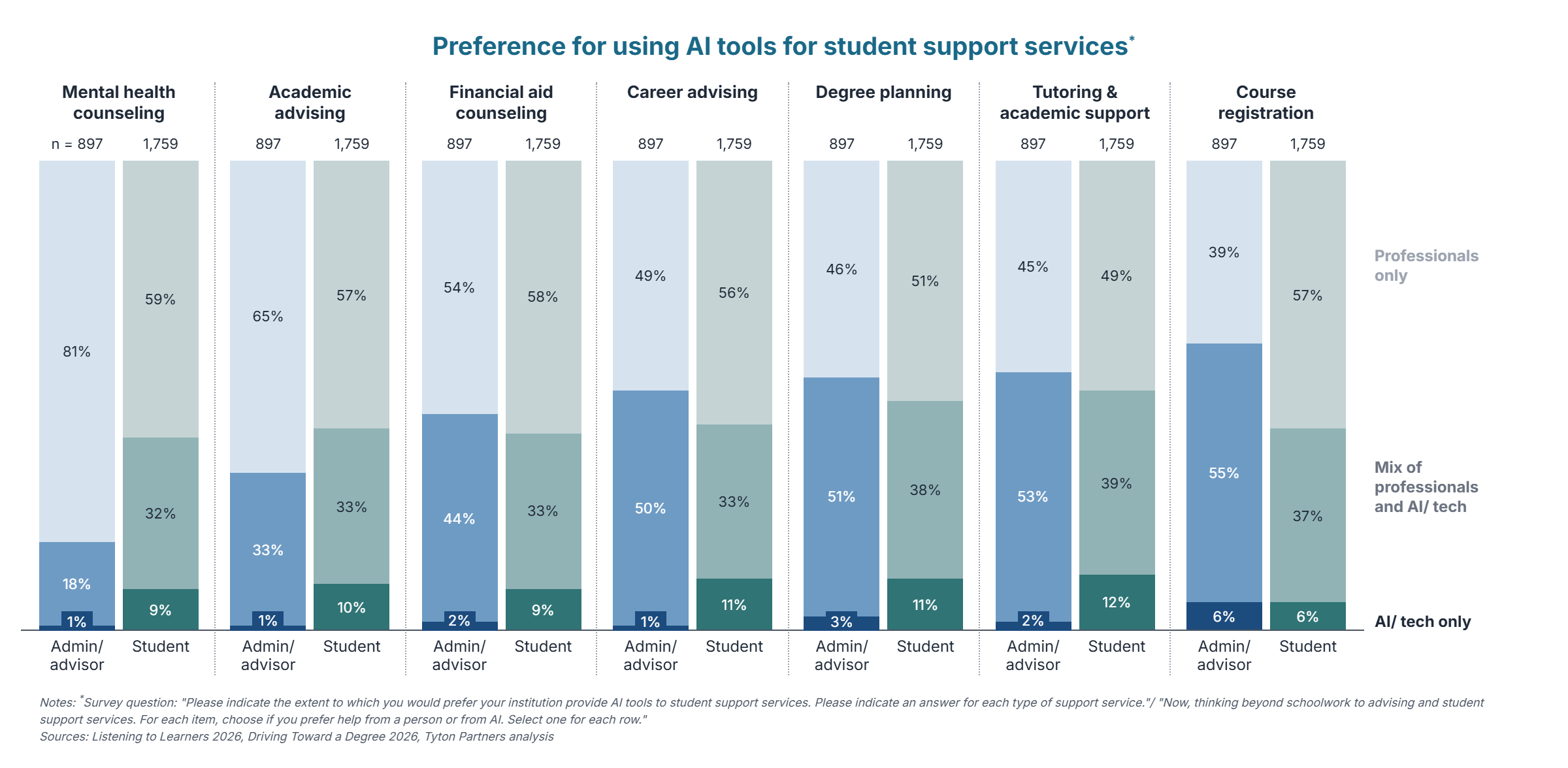
Students are pragmatic about where AI fits in their support experience. On average, 44% prefer some form of AI for student support services. Those who never use AI are 39 percentage points more likely to prefer humans only compared to frequent daily AI users. The preference for technology/AI as the primary delivery mechanism is highest for tutoring and writing support and degree planning, and lowest for mental health counseling. Students are most open to AI for logistics-heavy, transactional services, and most protective of human presence in high-stakes, relationship-dependent services.
Institutional preference is moving in the same direction. Among administrators and frontline staff, the blended approach rose +11 percentage points year over year to 42% on average, drawing from both the human-only and AI-only extremes.
Students and institutions are converging on a blended approach (part technology and AI and part human) to delivering student supports. That convergence is the foundation for deliberate implementation.
AI’s highest leverage opportunity is in freeing up advisors’ time
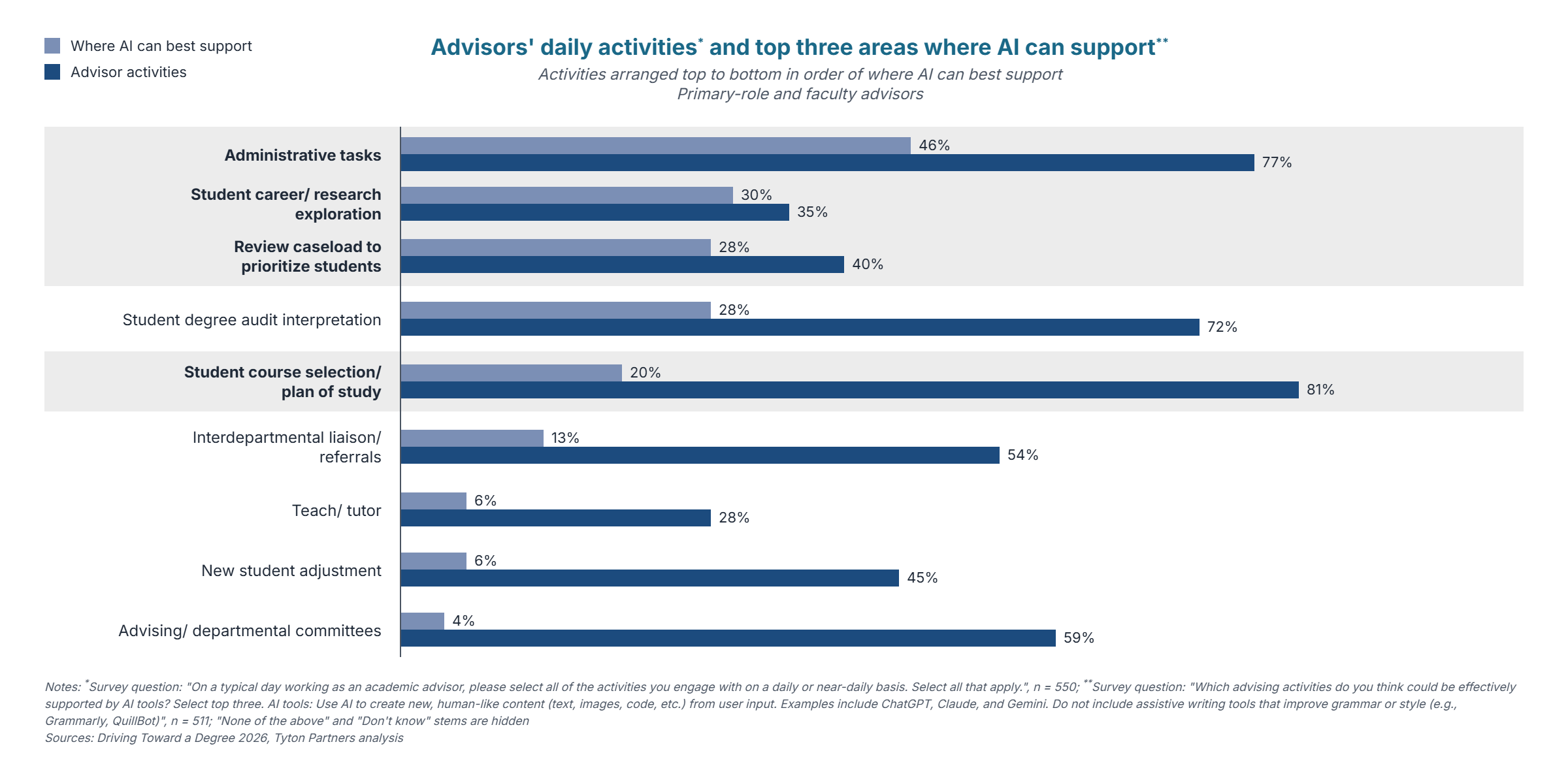
Administrative tasks consume nearly half of an advisor’s daily bandwidth, and advisors themselves identify it as the activity most readily handed to AI.
Beyond administrative, the bigger opportunity is career exploration. Only 27% of advisors believe students can identify relevant career pathways on their own. AI can surface options and flag relevant opportunities by student profile, not replacing the advisor’s guidance, but creating better conditions for it. Caseload prioritization follows the same logic: AI helping advisors identify which students need attention most, so limited time goes where it matters.
AI-augmented support is most wanted by students institutions struggle most to reach
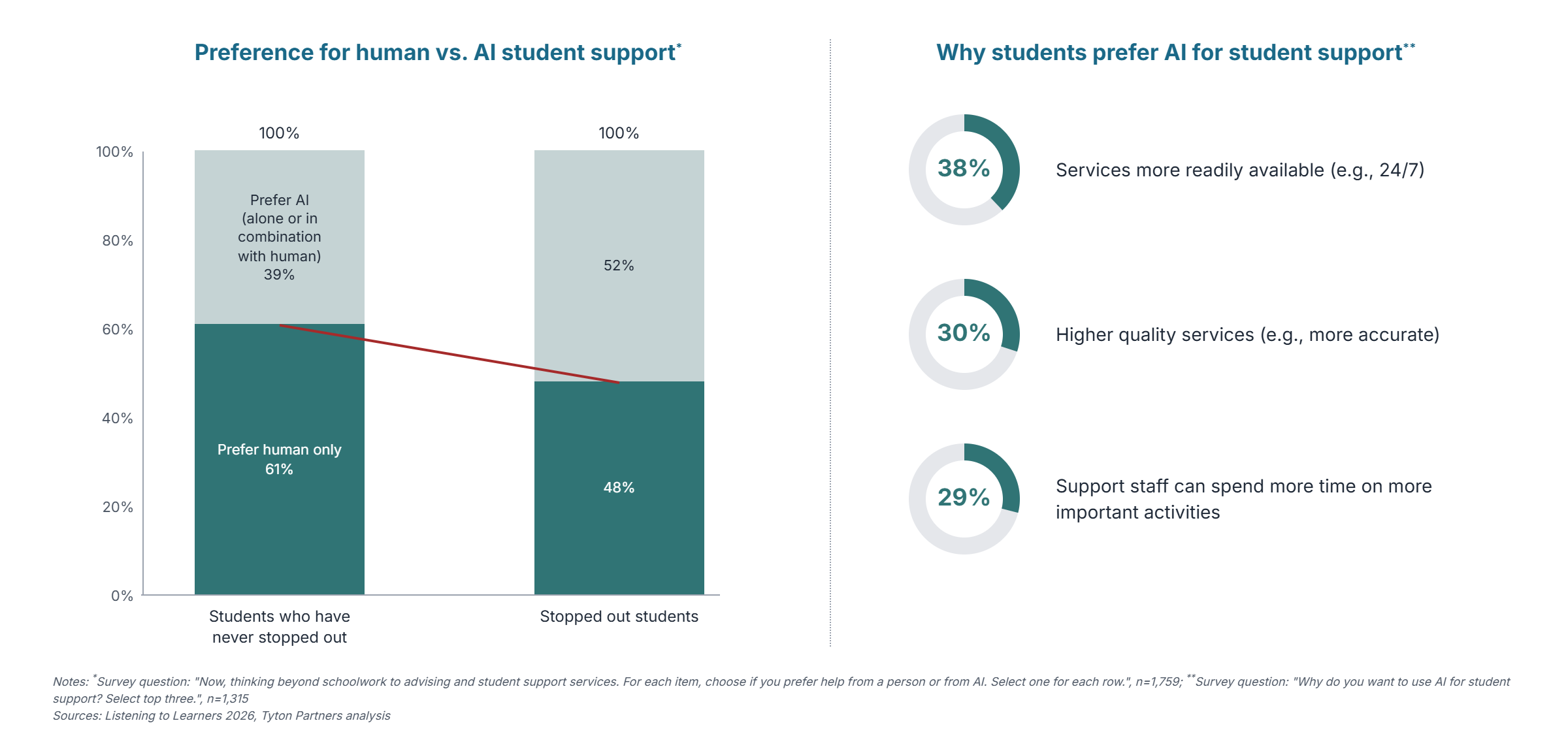
Students who have stopped-out at some point are a key population where preference tips toward AI or blended support over human-only. These are students whose lives don’t fit neatly into office hours. AI-augmented support, available on their schedule rather than an advisor’s calendar, is a more realistic fit for the conditions they’re navigating.
The broader utilization picture reinforces this. The second most common reason students don’t engage with available supports is inconvenient hours and access. The top reason students prefer AI for support is 24/7 availability. As one student puts it:

Institutions that have struggled to close the utilization gap have a structural solution here: AI-augmented support removes the access constraint that’s been keeping students out.
Students need to be in the room when AI policy is built, and almost none currently are
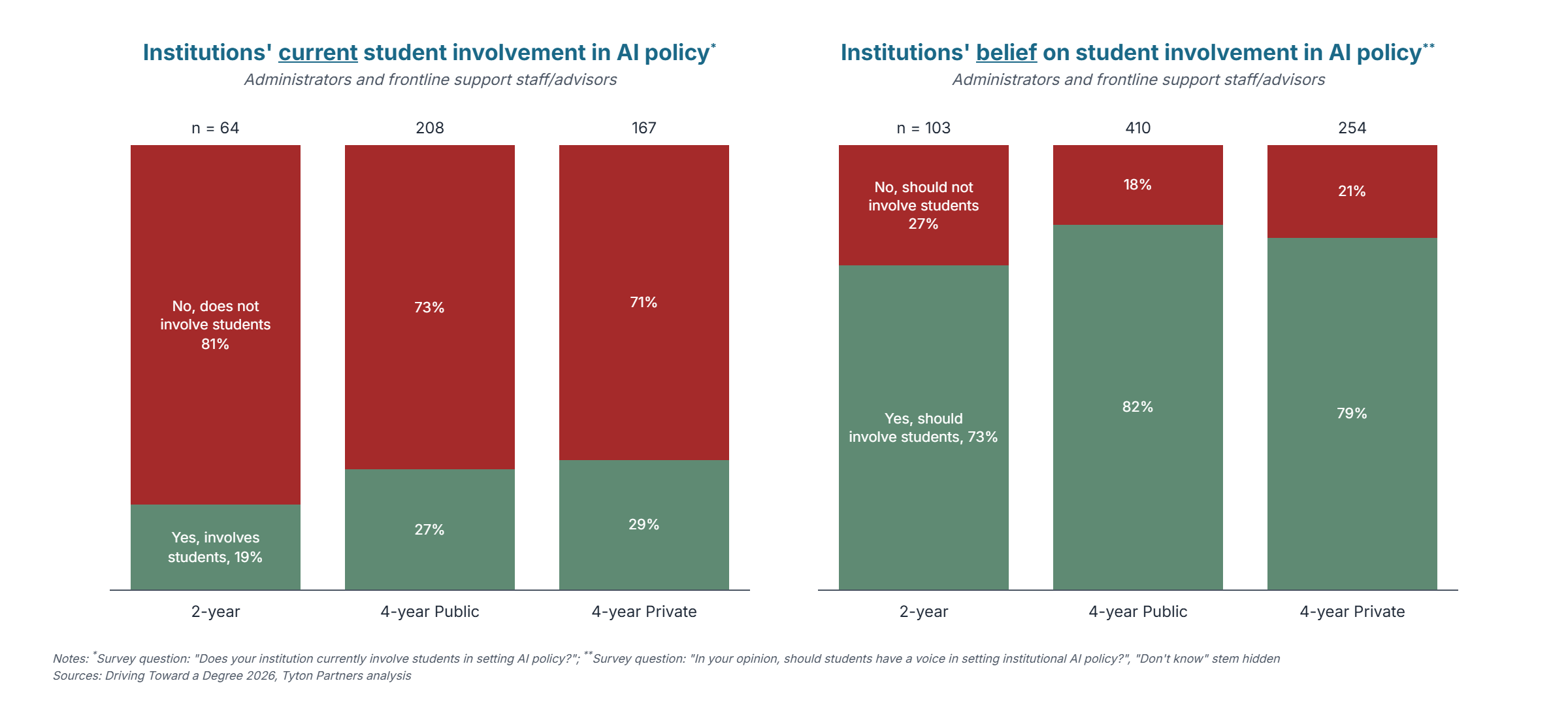
Across every institutional sector, institutional stakeholders overwhelmingly believe students should have a voice in setting AI policy. Yet, fewer than 30% of institutions currently involve them. That ~50 percentage point gap isn’t just an oversight, it’s a design risk.
AI tools built without student input are more likely to reflect institutional convenience than student need, optimizing for what is easy to automate rather than what students would use and trust. For institutions where trust is the persistent ceiling on AI adoption, closing the involvement gap is one of the most direct investments they can make.
The best positioned institutions to benefit from AI in student supports are those that are most deliberate about the division of labor. Administrative triage and career surface-matching are where AI earns its place. The human advisor’s time, freed by that handoff, is what makes the rest of the model work. For stopped-out students especially, that model extends further: AI-augmented access can be a re-engagement strategy for a population institutions have consistently struggled to hold. Getting there requires building with students, not just for them.