
Students Are Benefitting From Responsible AI Use
AI has moved from novelty to norm and the students using it most are more likely to self-report confidence, career-readiness, and persistence.
A majority of students now use AI tools regularly, often ahead of their faculty and advisors, and those who use it most are carrying less workload stress, demonstrating stronger academic confidence, and turning to AI for support beyond the classroom.
The question for institutions is no longer whether to engage with AI, it’s how to move more students from casual experimentation to purposeful, high-impact use through permissive policies, integrated tools, and early guidance on what effective AI use looks like. Time for Class 2026 reports just 32% of institutions having rolled out a central (top-down) AI policy, suggesting that institutions are playing catchup with individual student use outpacing clear top-down direction.
Students report experiencing differences in AI policy at the classroom level, and this means students may need to track multiple different AI policies every term. When some faculty are focusing on restriction while others are embracing new use cases, students have to spend extra effort bridging different ends of the spectrum rather than putting that effort towards learning outcomes. In their own words, when asked about the GenAI policies their institutions are implementing, students cite the ways in which policies lack uniformity:

AI usage as matured across all stakeholders, agentic AI is the next learning curve
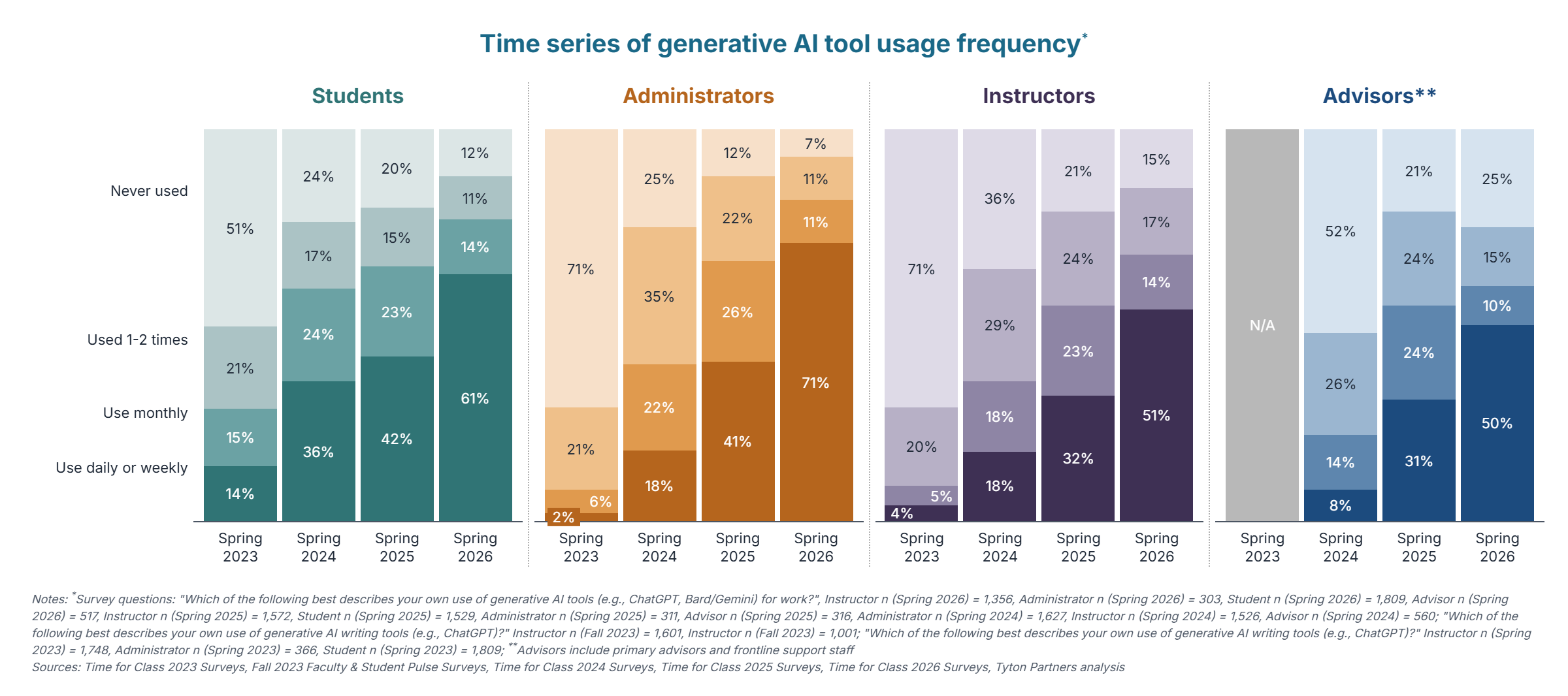
For the first time in four years, administrators are the most active daily AI users (43%), surpassing students (32%), faculty (25%) and advisors (28%). Daily use has now become a norm across all stakeholder groups. This signals that AI adoption in higher education has crossed a threshold from early experimentation and now to day-to-day reliance.
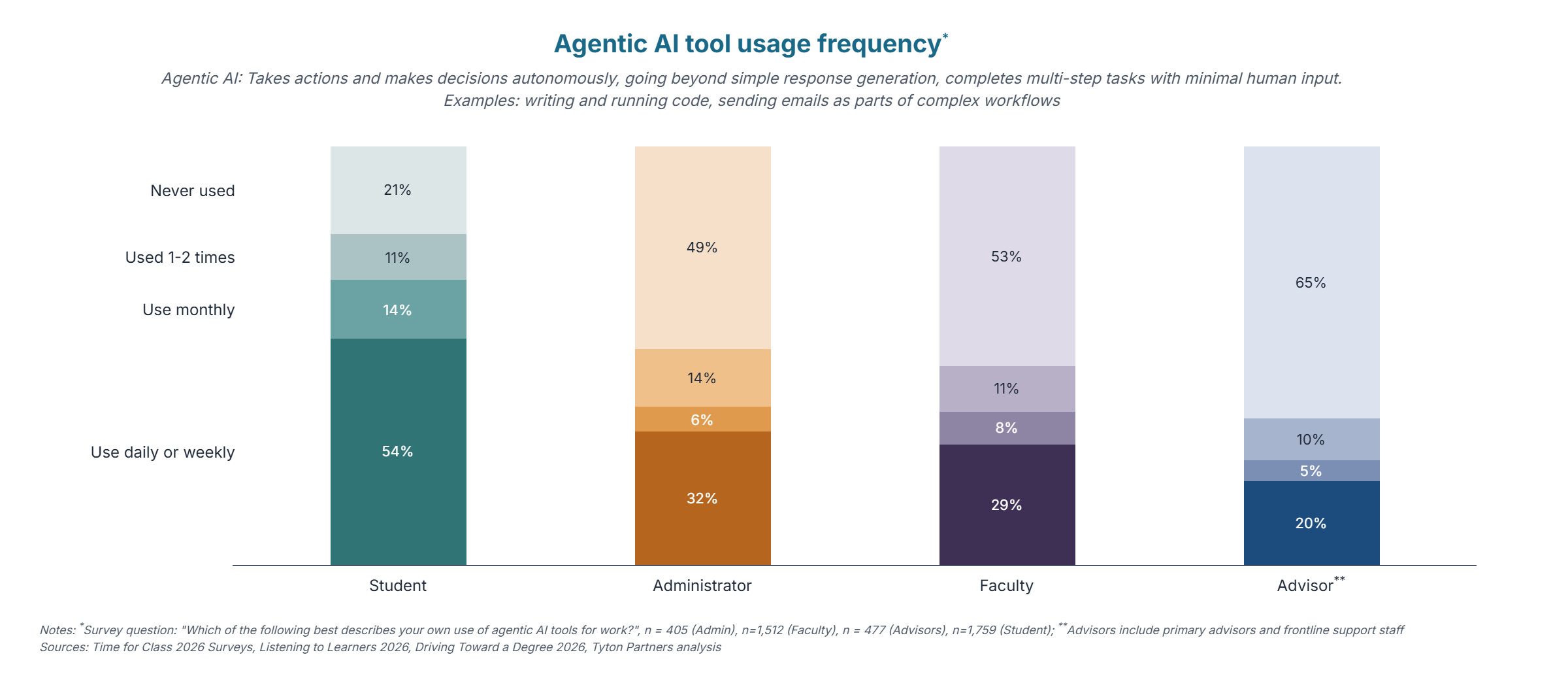
But even as institutions close the gap on familiarity with generative AI, students are already moving to the next frontier, agentic AI. 54% of students use agentic AI daily or weekly, compared to just 32% of administrators, 29% of faculty, and 20% of advisors. The pattern that defined generative AI adoption four years ago is repeating itself. Students adopt first; institutions follow. For institutions still building generative AI policy and practice, that gap is a preview of what comes next. The question is not whether agentic AI will reach higher education. It already has and institutions that wait to engage with agentic AI risk falling behind a student body that isn’t waiting for them.
For students under the most pressure, AI is a support strategy
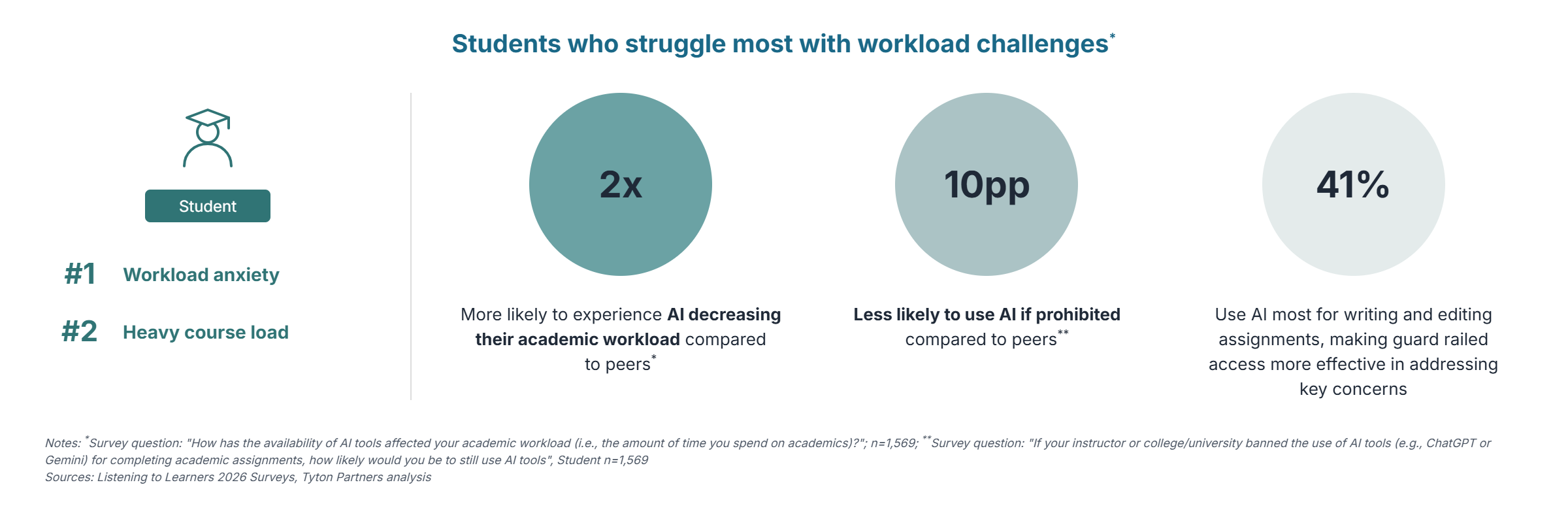
The students who need the most support are finding it in AI. Students whose top classroom challenges are workload anxiety and heavy course loads are twice as likely to report that AI is reducing their academic burden compared to peers.
These students are also 10 percentage points less likely to say they would stop using AI if prohibited, meaning restriction is least effective precisely where the need is greatest. For overwhelmed students, responsible AI access is a support strategy. Guard railed, institutionally-sanctioned access, rather than blanket restriction, is more likely to address their needs while maintaining academic integrity.
AI is increasingly acting as an academic resource
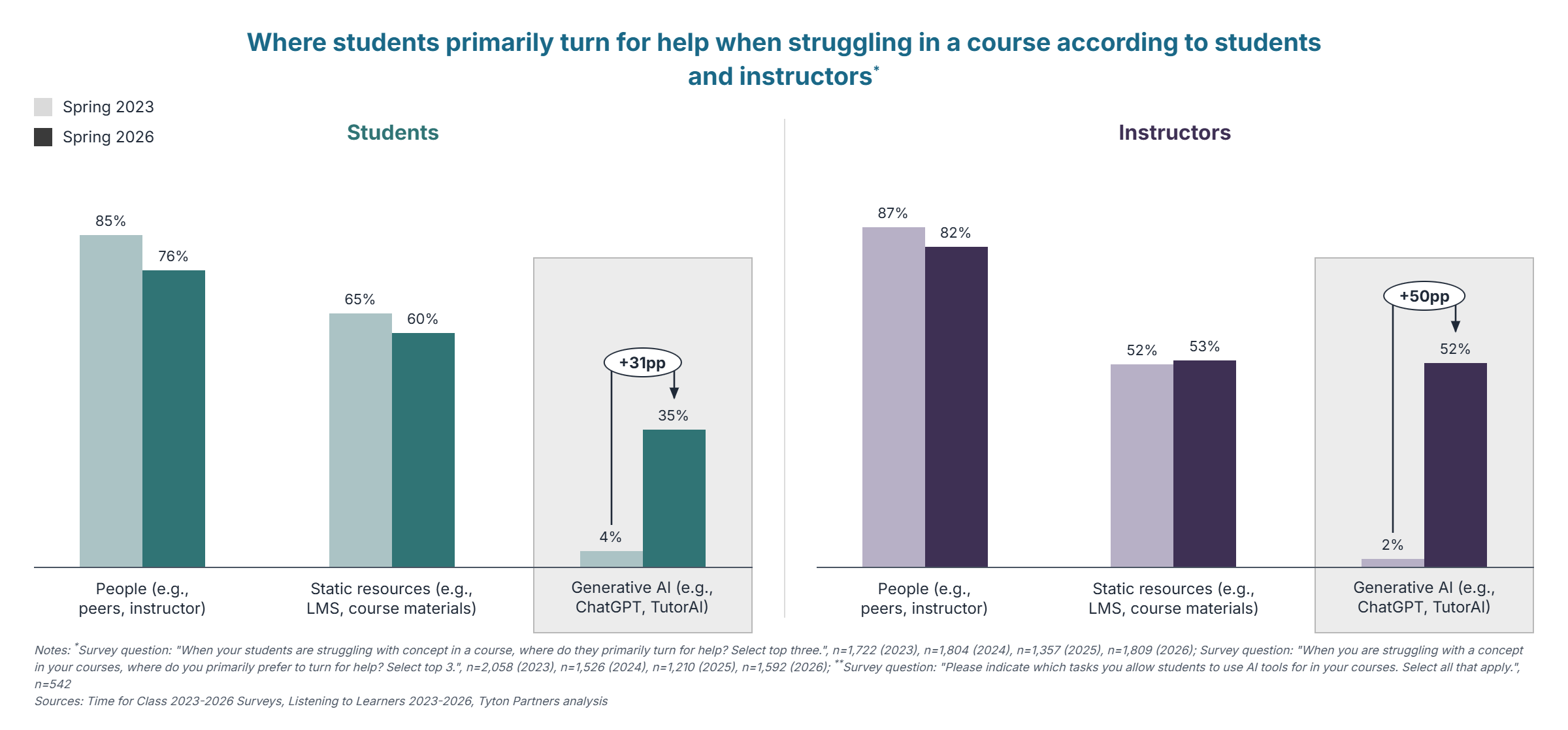
Students are increasingly turning to AI when struggling in a course, up 31 percentage points since 2023. Faculty, in turn, believe students are using AI more frequently than they report. 47% of faculty allow AI for generating study materials and 42% permit it for tutoring support. People and static resources remain the first stop, but AI is closing the gap. One student highlights a potential reason why:

Students have moved into broad, measured AI practice
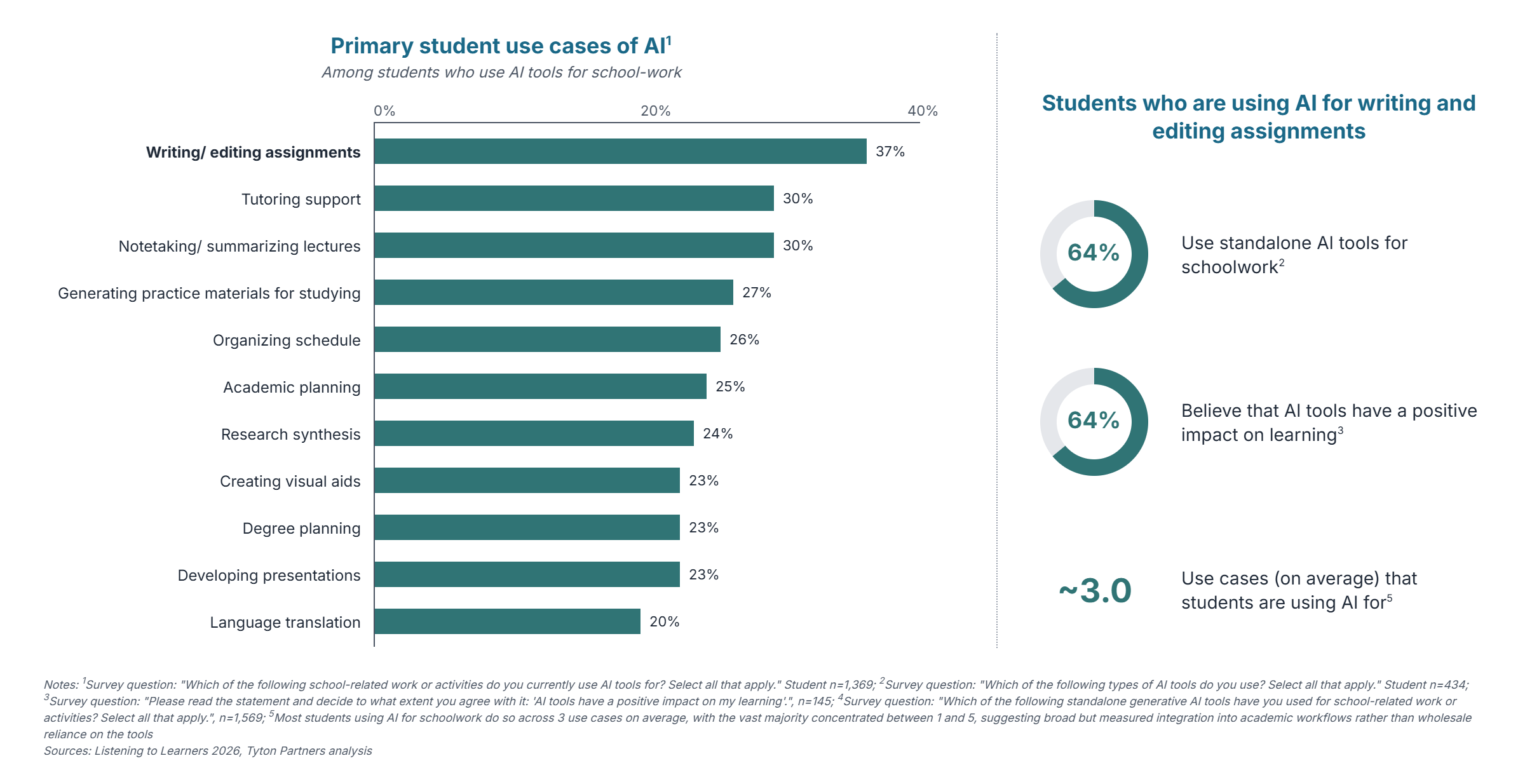
Despite inconsistent classroom-level AI policies, students are moving forward with establishing their preferred AI use cases. Writing and editing assignments is the top use case overall, but the breadth of how students are using AI tells a more interesting story. Students average three AI use cases, such as for notetaking, research synthesis, and degree planning. This suggests measured integration into academic workflows as the path forward rather than wholesale reliance on any single tool.
There are benefits for students (and faculty) who use AI daily
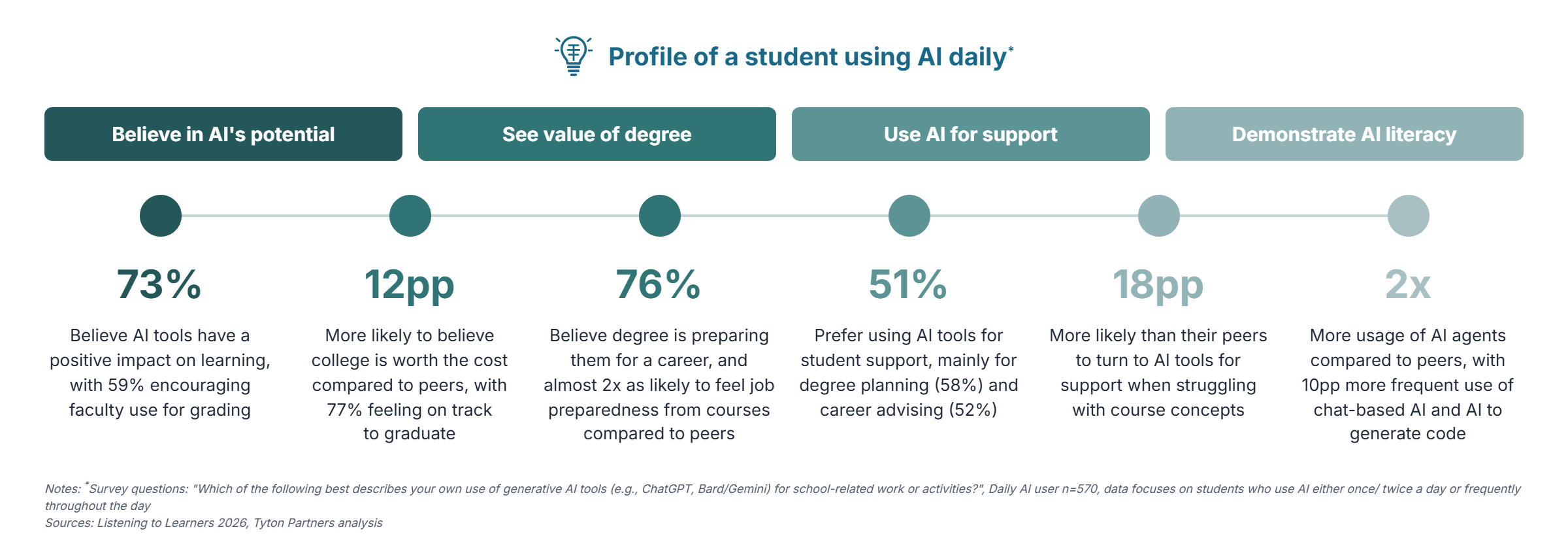
Student daily AI users have a distinctly different relationship with their education. Daily users are 12 percentage points more likely to believe college is worth the cost, 18 percentage points more likely to believe their degree is preparing them for a career, and twice as likely to use agentic AI compared to their peers.
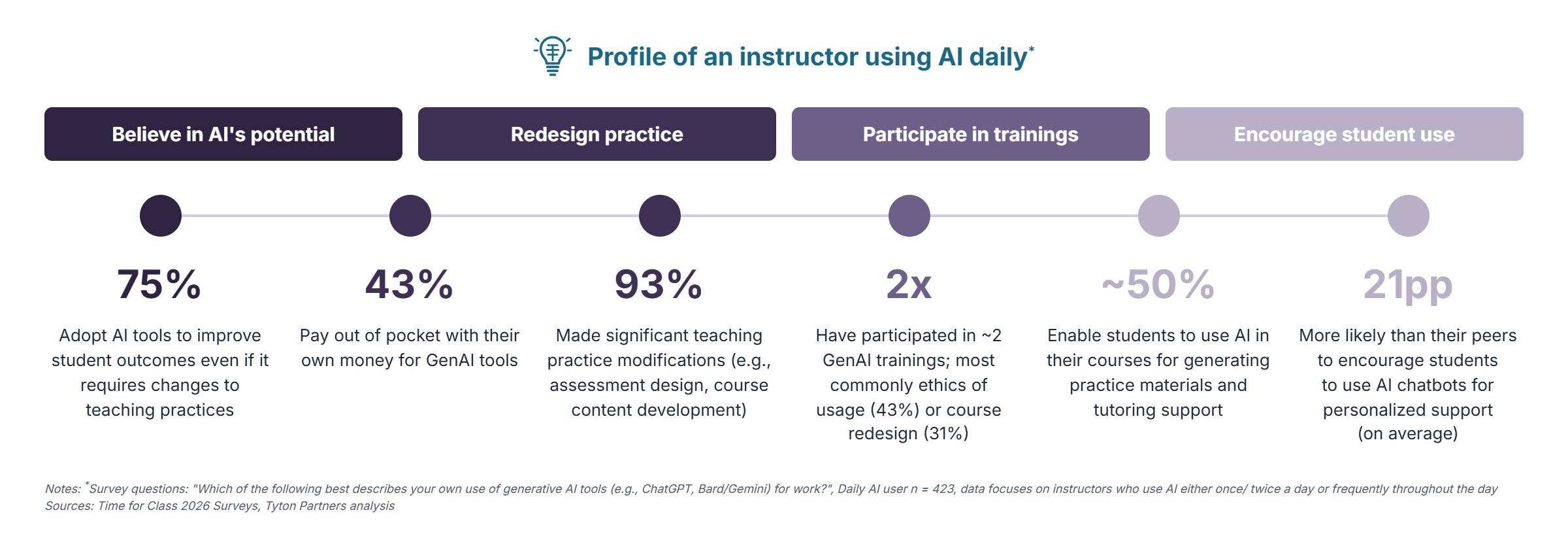
The pattern holds on the faculty side. Daily AI-using instructors are deeply invested. 43% pay out of pocket for GenAI tools and 93% have redesigned their teaching practices as a result. That commitment translates directly to students: they are 21 percentage points more likely than peers to actively encourage student AI use for personalized support.
Similarly, according to Driving Toward a Degree 2026, daily AI-using advisors are the most convinced AI can help with their caseload strains. What holds them back is capability, not conviction, with advisors citing staff training, not skepticism, as their top barrier to broader AI implementation.
Institutions looking to move more students toward purposeful AI use have a ready lever in the faculty who are already there. Responsible guardrails in policy and practice are what allow students and institutional stakeholders to benefit at scale.
AI adoption in higher education has crossed a threshold, moving the conversation to whether and how institutions are creating the conditions for that use to be purposeful. Students who engage with AI deeply self-report stronger confidence, greater career-readiness, and a better sense of their post-graduation trajectory. Among the 1 in 2 students who would use AI even if prohibited, career preparation is a primary driver. Permissive policies, integrated tools, and early guidance on effective AI use are key investments to drive student success in the age of AI.